We continue to be astounded because we tend to be a nation that advocates, even reveres, “proselytizing.” We want others to embrace our ideals while we fail to practice them ourselves and we resist allowing others the right of proselytizing theirs.
Wikipedia.org defines proselytising as “the act of attempting to convert people to another opinion and, particularly, another religion. The word proselytize is derived ultimately from the Green language prefix ‘πρός’ (toward) and the verb ‘ηλυτος’ (went). Historically … the word proselyte denoted a gentile who was considering conversion to Judaism. Today, the connotations of proselytizing are often negative and the word is commonly used to describe attempts to force people to convert; however, this article will be using it in the more neutral meaning of attempting to convert.”
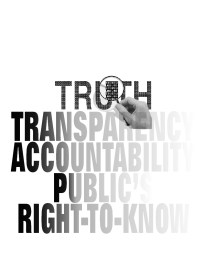
We continue to shake our head because we tend to be a nation that wants to proselytize the concept of transparency and openness in government to nations around the globe … while on the home front, we look the other way. With alarming regularity, we see instances of government agencies trying to shield actions and deeds from public they serve.
Transparency is a way of protecting fairness and ensuring the common good. When citizens know what their government is up to, they have a better chance of ensuring that decisions treat everyone equally and protect the common conditions that are important to everyone’s welfare.
As the Carter Center puts it: “Democracy depends on a knowledgeable citizenry whose access to a range of information enables them to participate more fully in public life, help determine priorities for public spending, receive equal access to justice, and to hold their public officials accountable. Inadequate public access to information allows corruption to flourish, and back-room deals to determine spending in the interests of the few rather than many.”
In a Carter Center sponsored 2008 study entitled Access to Information: A Fundamental Right, in answer to the question: “Why should ordinary citizens care about access to information?” – the following response is provided.
“I am often asked why people who sometimes don’t have even pennies to their name should care about a right that to them seems very distant, such as the right to information, and my response is simple: citizens should care because information allows them to participate in priority setting and decision-making, to hold their government accountable, and to assure equal treatment and equal justice. Information belongs to the people; governments simply hold information in their name. Public documents include anything from a birth certificate to a contract for road construction to studies that underpin public policy.
“The right to information was considered so important that when former South African President Nelson Mandela was drafting their new democratic constitution, he made certain that this was one of the first rights included. Mandela understood that it is a lack of information and a lack of knowledge that allows systems such as apartheid to thrive. With information, citizens can better secure their democratic rights.
“With an access to information law, governments must establish record keeping and archiving systems, which serves to make them more efficient, reduce discretionality and allow them to make better decisions based on factual information. Moreover, greater transparency can help reestablish trust between government and its citizens.
“Changing a culture of secrecy to one of openness is a difficult task that can take generations. However, a first step is to raise the community’s awareness of their right to information. In many Latin American countries, the constitution provides a right to information. In other countries, governments have signed international instruments or declarations for a right to information. In addition, it is important for legislatures to pass comprehensive laws that set out the procedural framework for requesting and receiving the information.
“There used to be very few countries in the world with freedom of information laws, such as the United States, Canada, and Sweden. However, in the past decade, more than 50 countries have passed access to information laws. Although many governments are struggling with the difficulties of implementation, they remain committed to providing an expansive right to information. This is in stark contrast to what is happening in the United States. Following Sept. 11 and the passage of the Homeland Security Act and the Patriot Act, we have seen a tendency to restrict access to public documents, in some cases using national security as a pretext for subverting the right to information.
“Access to information is a fundamental right. Allowing people to seek and receive public documents serves as a critical tool for fighting corruption, enabling citizens to more fully participate in public life, making governments more efficient, encouraging investment, and helping persons exercise their fundamental human rights.”
1998 study shows how to build transparency
“(the author) highlighted several approaches to building transparency. These included supporting the freedom of information movement and efforts to protect journalism, increasing the judiciary’s independence, demanding transparency in financial sectors, and forming integrity pacts to assure honest public procurement.
“Citing the work of George Akerlof, he noted that when sellers have more information about the quality of goods than buyers, good and bad products must sell at the same price, and the market price favors the poor quality goods, or ‘lemons.’ This principle also applies to stocks, bonds, commodities, labor, and any production process. The buyer must assume the worst and pay a low price. This drives legitimate sellers out of the market and reduces aggregate demand.
“Transparency may be inconvenient, expensive, and often personally uncomfortable for policy-makers, but … government intervention to assure transparency is warranted, benefiting private firms and society as a whole. It can improve pricing and asset valuation and help prevent policy mistakes and overreaction when problems occur.
“Establishing transparency is part of establishing government credibility. It requires submitting to the accountability that the democratic process provides and the legal recourse offered through an independent judiciary.”
Attempts to restrict open communication; to deny or hamper access to documents and transgress citizen rights are particularly evident in certain local governments. Clearly, one can see from the above Carter Center initiatives that the control of open communication, while manacling and trampling citizen rights, that there is a need for proselytizing for transparency here … at home!
 Columbia news, views & reviews