We humans have long been interested in defining the abilities that set us apart from other species. Along with capabilities such as language, the ability to recognise and manipulate numbers (“numerical competence”) has long been seen as a hallmark of human cognition.
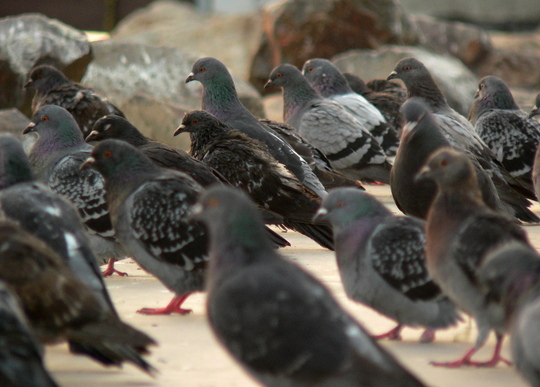
In reality, a number of animal species are numerically competent and according to new research from psychologists at the University of Otago in New Zealand, the humble pigeon could be one such species.
Damian Scarf, Harlene Hayne and Michael Colombo found that pigeons possess far greater numerical abilities than was previously thought, actually putting them on par with primates.
More on pigeons in a moment, but first: why would non-human animals even need to be numerically competent? Would they encounter numerical problems in day-to-day life?
In fact, there are many reports indicating that number is an important factor in the way many species behave.
Brown cowbirds are nest parasites – they lay their eggs in the nests of “host” species; species that are then landed with the job of raising a young cowbird.
Cowbirds are sensitive to the number of eggs in the host nest, preferring to lay in nests with three host eggs rather than one. This presumably ensures the host parent is close to the end of laying a complete clutch and will begin incubating shortly after the parasite egg has been added.
Crows identify individuals by the number of caw sounds in their vocalisations, while lionesses appear to evaluate the risk of approaching intruder lions based on how many individuals they hear roaring.
But numerical competence is about more than an ability to count. In fact, it’s three distinct abilities:
- the “cardinal” aspect: the ability to evaluate quantity (eg. counting the number of eggs already in a nest)
- the “ordinal” aspect: the ability to put an arbitrary collection of items in their correct order or rank (eg. ordering a list of animals based on the number of legs they have, or ordering the letters of the alphabet)
- the “symbolic” aspect: the ability to symbolically represent a given numerical quantity (eg. the number “3” or the word “three” are symbols that represent the quantity 3).
To continue reading this article from The Conversation, click here.
 Columbia news, views & reviews