 Birdbrains or copycats: Aesop’s fable offers insight as to how children and birds think. ‘Playingwithbrushes’
“Humans are very good at innovating and it would seem reasonable to expect our children would be too. But a recent study questions these assumptions, suggesting young children’s ability to problem-solve is surpassed by birds.
“When primatologist Jane Goodall first reported that chimpanzees strip leaves from twigs to fish for termites, archaeologist Louis Leakey famously responded: ‘Now we must redefine tool, redefine Man, or accept chimpanzees as humans.’ Certainly, we can no longer lay claim to the title of the planet’s only tool-making animal.
“Yet we remain without peer when one considers the depth, breadth, and inventiveness of our tool use.
“There is every reason to believe that chimpanzees living 200 years ago stripped leaves from twigs, much as they do today. We, in contrast, have gone from building buggies for our horses to vehicles with an output roughly equivalent to that of 1,000 horses.
“The crow and the pitcher
Imagine you are incredibly thirsty and you stumble across a pitcher of water, only to discover that the little water left at the bottom can’t be reached. What would you do?
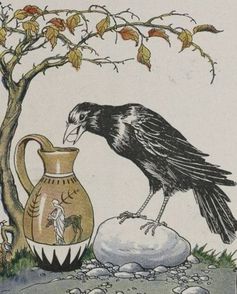
“This problem was famously played out in one of Aesop’s fables The Crow and the Pitcher. The protagonist, a crow, worked out the solution: drop stones into the pitcher until the water rises high enough to be drunk.
“As it turns out, corvids (the family crows belong to) can and will do this if presented with an analogous problem. Rooks will drop stones into a thin perspex container, partially filled with water, in order to raise the level enough to retrieve a floating worm – although their behaviour in this scenario seems likely driven by instrumental learning (learning that performance of particular actions increases the probability of a reward) rather than any deeper insight.
“When presented with this problem, chimpanzees, our closest living animal relative, can work out a solution too.
“Given evidence that the mental abilities of young children and chimpanzees are similar, one would expect our offspring to master this test with ease. But they don’t.
“Fable or truth?
“In a study recently published in PLoS ONE, Cambridge PhD student of Experimental Psychology Lucy Cheke and her colleagues presented children aged between four and ten years with a series of tasks that required objects to be dropped into tubes of water to raise a floating object high enough to be retrieved.”
Click here to read this article from The Conversation in its entirety.
 Columbia news, views & reviews