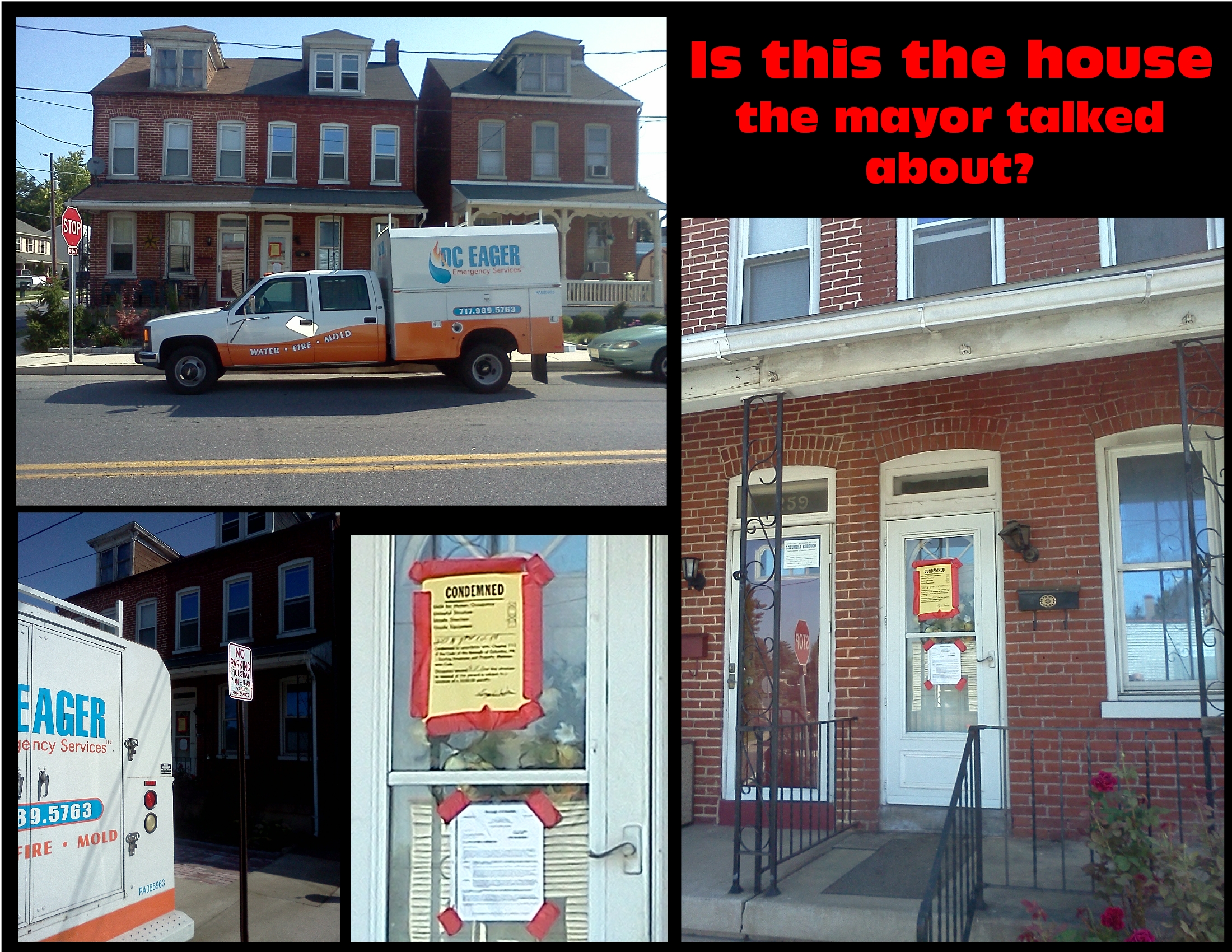
The few citizens remaining at the adjournment of the August council meeting-of-the whole missed out on a few key items introduced by the mayor.
“the worst I’ve seen”
Mayor Leo Lutz shared some pictures with borough councilors that were taken by codes personnel. The mayor said, the pictures represented a home in town that was probably “the worst home that I have seen during my 11 years as mayor.” The mayor did not divulge the address of the house to meeting attendees; he did say it was “owner-occupied” but clarified that saying the house was occupied by the daughter of the owner.
Codes department personnel tried to gain entry into the house, but were repulsed by the putrid stench within the house. The mayor said there was evidence of “vermin” and extremely unsanitary conditions in the house. The codes department personnel subsequently condemned the property.
There were children in the house and there were two dogs kept in the basement. The mayor said the dogs never left the basement; they were “trained” to relieve themselves in the basement. “There were over 150 dirty diapers in one room,” said the mayor. The mayor asked the codes officer to contact Children and Youth services to get that agency involved
The mayor asked council to find ways to intercede when houses with conditions like these are reported and found.
The mayor said he saw “perpetual yard sales in front of this house” over the past few months. The mayor asked the council to find a way to take swift action in cases like this.
The borough manager interjected that the law does not allow the borough to act without obtaining a search warrant. The legal process must be observed, and the property owner must be informed and allowed time to remedy the situation.
Codes department personnel and a remediation company were dispatched to attend to the possible bio-hazard conditions in the house.
“We need to jump on these things as fast as possible,” said the mayor.
Emergency response issues
Mayor Lutz related that there were some “issues” among emergency response personnel during the recent recovery incident on the Susquehanna River. The mayor indicated that he wanted to have a post-incident critique involving Columbia Borough emergency responders. One councilor commented on verbiage and context of the mayor’s observation; the borough manager injected that “lessons learned” are very worthwhile actions that ought to be part of all incidents.
One councilor asked when the after-action report from the Cycle Den fire incident would be shared with the council. Another councilor retorted that the post-incident report process is verbal and not written and it is not shared with councilors nor citizens.
Interestingly, jurisdictional adoption of the National Incident Management System stipulates and mandates that the jurisdiction must “institutionalize the Incident Command System” and “jurisdictions will be considered to be in compliance the NIMS by adopting the Incident Command System and NIMS principles and policies.” According to the Emergency Management Management Handbook for Elected Officials “elected and appointed officials should be aware of how NIMS can work to ensure cooperative response efforts, thereby minimizing the potential implications of an incident.” The adoption of consistent post-incident evaluation procedures are always embraced in progressive communities.
The United States Fire Administration (USFA) states “The key to successful critiques is having and enforcing a written policy that establishes a systematic and standardized approach for conducting them and clearly explains the purpose and objectives of evaluating the department’s responses to incidents. The policy should lay out the process and define which types of incidents will undergo a critique: informal or formal. By establishing a critique policy, the fire department can ensure that every after-action review is conducted in a consistent manner and achieves the goals intended.”
“Following the critique, the fire department should brief appropriate local government officials as to its preliminary findings. Local officials often are besieged with inquiries from citizens and the press after a major incident. Local government officials need accurate information so they can be responsive and provide accurate information to the public.”
Critiques, “hot washes”, after-action reports (AAR) provide building programs and enhance the safety and response for future incidents. AARs for the an apartment fire in Gloucester, MA and the Dixie Crystal explosion and fire are two examples of effective “lessons-learned” AARs.
Anti-bullying programs
The mayor also promised that the police department will continue to introduce anti-bullying programs in the schools in the borough. He said “Vision Columbia” has a program called “Safe Passage” that would also play into countering bullying issues and “possible child abduction.”
 Columbia news, views & reviews
yes it is me house, all i can afford, and as long as borough council doesn’t do anything to make me change it will remain this way.