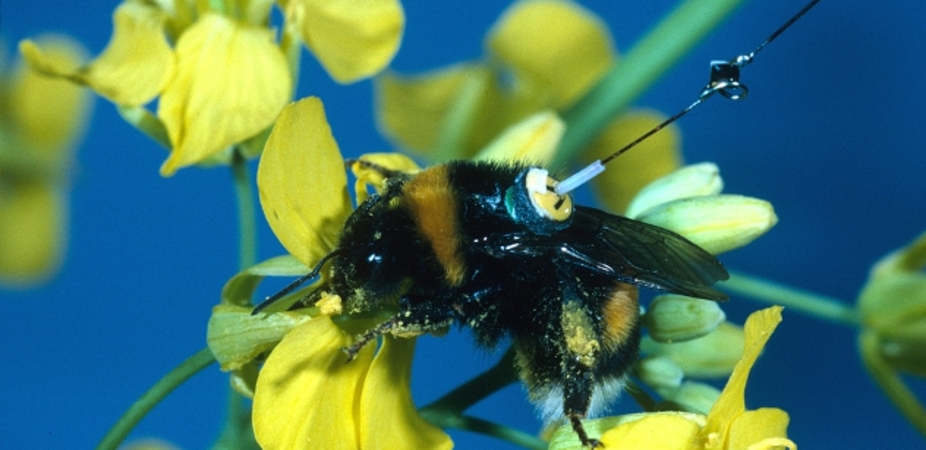
 By attaching a small transponder to bees, researchers were able to track movements and feeding patterns. Andrew Martin
“How do insects, given their poor visual resolution and small brains, cope with the huge challenge of finding food at more than one location and returning home immediately afterwards, day after day?
“Mathieu Lihoreau and colleagues from Queen Mary University of London have come up with a very clever experimental design to answer this question in bumblebees (Bombus terrestris) – and their study is published today in PLoS Biology.
“We knew already that animals of all varieties use a range of navigational information available in the environment. That ranges from using the sun as a compass, the earth’s magnetic field, distinct visual landmarks in the panorama and occasionally even scent.
“But food sources animals rely on often get replenished on a daily basis (e.g. nectar in flowers or ripened fruits on a tree). Hence animals that use such food sources have to develop robust strategies to find multiple food locations, while always knowing where home is.
“A closer look at the study
“Working in the pasture lands of Rothamsted estate, UK, Lihoreau and colleagues trained bees to collect sugary solutions from artificial flowers. After training, the researchers then tested individual bees by arranging the artificial flowers in a pentagonal shape (see image above).
“Tracking insects, especially flying insects, in an outdoor environment has been a huge challenge. Here, the authors caught individual bees that were leaving the hive and attached a small transponder (weighing 0.8mg) and released them.
“The coordinates (latitude and longitude) of the tagged bee were then tracked using a harmonic radar which provided an accurate flight path for each bee.
“With increasing experience, bees not only visited more flowers before returning to hive, but the sequence in which they visited the five flowers also become more similar.
“Bees very quickly then determined the shortest possible route from one flower to another. The radar tracks of the bees (see image below) clearly show that flight paths are very straight, both between the nest to the flower and between flowers.
“The distance to travel the shortest possible path to visit the five flowers was about 310m. Inexperienced bees travelled much greater distances (about 1,950m) to visit the same five flowers, whereas the experienced individuals travelled only about 460m – much closer to the shortest possible route.”
To continue reading this article from The Conversation, click here.
 Columbia news, views & reviews