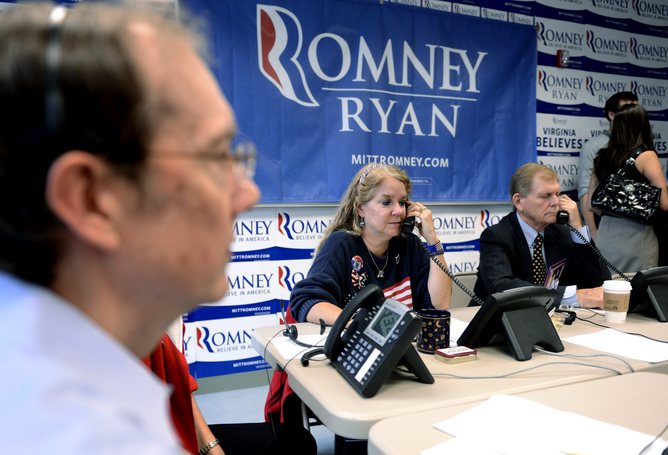
 Volunteers work the phones to “get out the vote” for the Romney/Ryan campaign in Virginia. EPA/Shawn Thew
“For America’s democratic institutions to be legitimate, the electorate needs to reflect the population. Instead, states around the country have passed the restrictive voting laws; laws that will restrict ballot access for an estimated five million Americans.”
“Hurricane Sandy will leave more than physical destruction in its wake. Arriving just days before the US presidential election, the storm could have a political fallout as well.
“Sandy has affected the key battleground states of Virginia, Ohio, and Pennsylvania, and may complicate matters by shutting down early voting, at least for a few days. Turning out early voters was a key aspect of Obama’s ground game. It is unclear whether voters who would have voted early in those states will turn out on election day or simply stay home. Generally, inclement weather or obstacles to voting benefit Republican candidates and decrease turnout among racial/ethnic voters, who are key to Obama’s electoral success.
“But how important is ‘getting out the vote’ in the US?
“When I present my research on get-out-the-vote efforts, audience members (mostly youth) often ask, “Why should we care about voting? It doesn’t really matter anyway.”
“My answer is to point out the significant time, resources, and political capital that has been spent, just over the past few years, passing laws that restrict voter registration efforts and establish voter identification requirements in the United States – laws that the Brennan Center for Justice estimates will disenfranchise the 11% of the eligible voters that do not have a government-issued photo ID. That percentage is higher among the elderly, the poor, voters of colour, and those with disabilities.
“What America needs is a movement to expand political participation, rather than restricting it. In 2008, 56.8% of the voting age population turned out to vote, which is closer to what can be expected in Burundi or Congo than France or Australia. Given the 2008 US voting age population was about 230 million, that leaves over 99 million Americans who were eligible to vote but chose not to go to the polls.
To read this article from The Conversation in its entirety, click here.
 Columbia news, views & reviews