
Photo source: votingamerican.wordpress.com
Near the very end of last night’s Council “committee-of-the-whole” meeting the announcement (we suggested two weeks ago) was dropped by Councillor Mary Barninger as she reported on one Personnel item: Councillor Renae Sears submitted her resignation from the council; the effective date of the resignation is today, November 21, 2012.
Council “had no choice” but to accept the resignation due to Sears’ impending move from the Borough.
When the meeting convened at 6:03 pm, the entire council, the mayor, the borough manager, the borough financial officer, the police chief, a recorder and three citizens were present. The borough officials mashed through the agenda items until the meeting was ended at 9:57 pm.
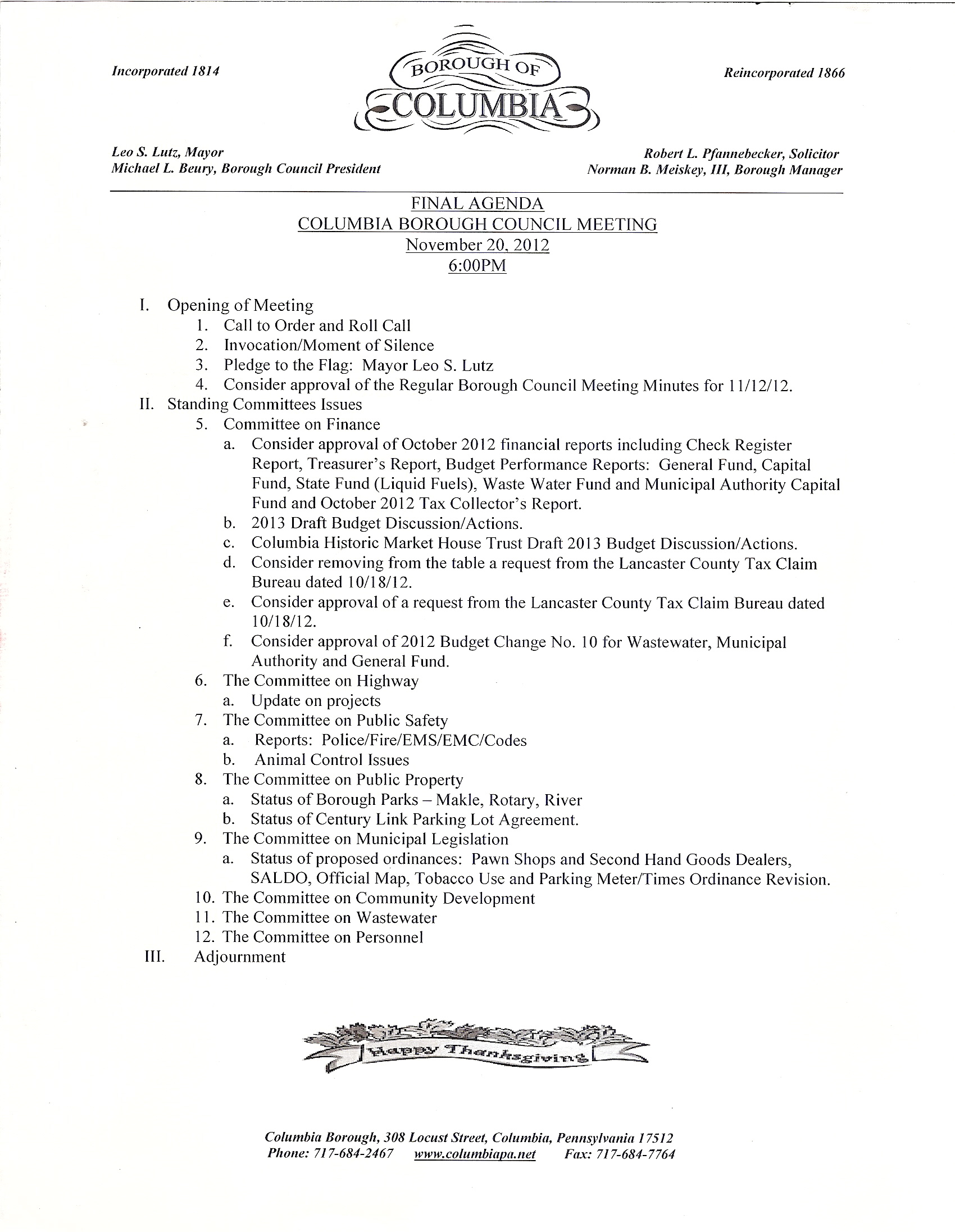
Each of the councillors led discussion for the separate Committees for which they held chair ownership. Deliberate conversation of Finance Committee matters, including the 2013 Budget, police department staffing; police department overtime; the borough’s fee schedule; animal control and other issues, held the spotlight for the first part of the evening.
The remaining agenda items spurred more discussion and a few non-agenda topics (waiving fees related to handicap parking for disabled veterans; replacing the police vehicle which was crashed several weeks ago; etc.) were also introduced.
Columbia news, views & reviews reminds citizens that the only way to be aware of what happens during scheduled council, committee, commission and board meetings is to attend and participate in the meetings. News reporting resources address only a portion of the proceedings.
Want to be considered for Borough Council? If you are interested and can satisfy the necessary requirements, make sure to make your interest known to the Borough Manager or one of the sitting councillors.
“The basic qualification to serve as a borough councillor is to be a registered voter and resident of the borough.
Councillors must have resided in the borough continuously for at least one year before their election. To continue
serving as a councillor, an individual must retain residence within the borough. To qualify as a voter, a
person must be eighteen years of age and a resident of the election district. A person whose name appears on
the district voting register but who is no longer a resident of the borough is not a lawfully registered elector.
Legal residence includes not only a person’s intention, but also a physical presence. The requirement of residence
approximates domicile. Intention or voter registration is not enough; the actuality of an individual’s residence
is better determined by conduct than by words. A person cannot declare a domicile inconsistent with the
facts of where one actually lives.”
The remaining councillors have to set in place the replacement of a councilor process. Here is the procedure as identified in the Columbia news, views & reviews article published on November 12:
“The most common reason for vacancies on council is through resignation. Individuals sometimes find the demands on their time, the pressure of private business activities, personal health or family problems or the responsibilities of office are too much to cope with. Vacancies can also occur because of death, moving out of the borough or ward, removal from office by the courts or failure to qualify.
“The Code provides for the remaining members of council to fill a vacancy by resolution. Pennsylvania county courts are divided on the issue of whether a resignation requires acceptance by the governing body or whether it is unconditionally effective. This is critical because of the timetable established to fill vacancies. The safest course for governing bodies is to take official action to accept any resignation and to fill the vacancy within thirty days of its submission.
“Commonwealth Court has ruled that a governing body member’s resignation was effective when tendered and accepted. The resigning officer establishes the effective date of the resignation and from that time the office is vacant. In this case, the court voided an action by the board to rescind the resignation acceptance at a subsequent meeting. The court held a vacancy existed on the board and could only be filled by action of the board members to appoint a successor until the next municipal election.
“Council has thirty days to take action to fill a vacancy. If council fails to fill the vacancy within the prescribed limit, then the vacancy board fills the vacancy within fifteen additional days by appointing a qualified person.
“The vacancy board consists of council and one registered voter of the borough who is appointed by the council and acts as the chair of the vacancy board. If the vacancy board fails to fill the vacancy within the prescribed time, the chair then petitions the court of common pleas to fill the vacancy. In the case of a vacancy in the chair, the remaining members of the vacancy board petition the court to fill the vacancy.
“Where more than a majority of the offices of councillor are vacant at any one time, the vacancies are filled by the court upon petition of at least fifteen registered voters of the borough.
“In all cases, the successor is appointed to serve until the first Monday in January following the first municipal election occurring more than sixty days after the vacancy occurs, if the term continues that long. At that municipal election, a successor is elected to fill any unexpired balance of the term. All persons appointed to fill vacancies must have all the qualifications required of elected officers.”
SOURCE: Borough Council Handbook – page 9
 Columbia news, views & reviews