
What if a rail tanker car containing chlorine was delivered mistakenly to a manufacturing plant just outside Marietta on Tuesday night?
What if what was supposed to be delivered was a tanker filled with non-hazardous, water-based paint compounds.
What if plant employees were advised by plant management about the rail carrier mis-cue and told not to go anywhere near the back of the facility.
A source informed Columbia news, views & reviews the “what if’s” did happen.
Nothing bad happened … why this “non-event” article?
Couple of reasons or questions come to mind.
Doesn’t the railroad have a consist?
Doesn’t somebody on that train have a responsibility to know the whereabouts of hazardous materials tank cars? Short answer: Yes.
For more information on railroad safety concerning hazardous materials, see these documents:
- Hazardous Materials, United Transport Union
- PowerPoint: Rail Corridor Safety Conference Freight Storage/Hazmat, Federal Railroad Administration
- HazMat Rules for Transportation, CSX
- DOT SECURITY PLAN FAQ’S, Harvard University Campus Services
Tanker cars containing hazardous material dropped at the wrong destination also represent a potential homeland security threat.
“In a complex supply chain, Toxic Inhalation Hazards (TIH) products are passed from producer to railroad carrier to end-user or consumer. The railroad carrier may switch the product from one train to another or to a different rail carrier (referred to as interchange). These handoffs create vulnerabilities: unattended tank cars could be attacked; accidental leaks might not be immediately detected.” – (SOURCE: Rail Transportation of Toxic Inhalation Hazards: Policy Responses to the Safety and Security Externality, HARVARD Kennedy School – Belfer Center for Science and International Affairs
“Railroads’ guarded secret: Not even HAZMAT teams are told what’s on train”
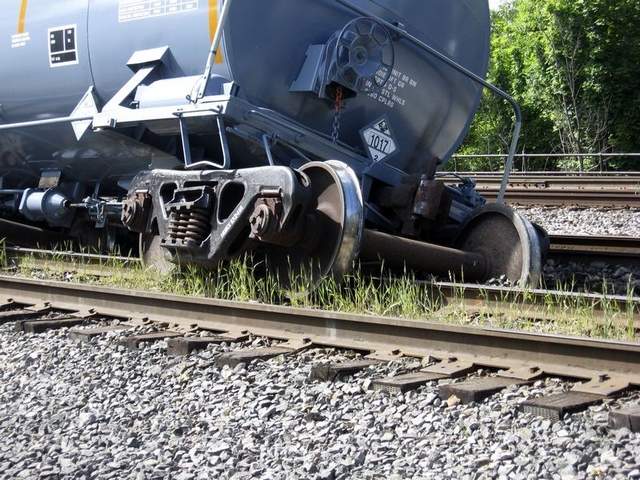 A tanker leans off the track near Crandall and Thorp streets in Binghamton after a June derailment of a Norfolk Southern train. The railroad didn’t notify local officials of the incident, even though there were residual amounts of chlorine and ammonia in the cars that derailed. Above, members of the Chemung County HAZMAT team practice sealing a tanker valve in a simulated chlorine-release incident. / Provided (SOURCE: Binghamton (NY) Press)
“Trains carrying deadly chemicals rumble through our backyards every day, but railroad companies hauling them refuse to publicly disclose exactly what those substances are, or how often they travel through the area.
“Only the railroads are required to know what’s in the cars they’re shipping, said Federal Railroad Administration spokesman Warren Flatau.
“Local emergency workers, who would respond to a leak, spill or fire, have no knowledge of what’s being transported on those cars until an accident happens.
“So what’s behind all the secrecy?
“And can local HAZMAT teams adequately prepare for emergencies if they aren’t sure which chemicals are being brought through and with how much frequency?
Click here to read this 2010 Binghamton Press article in its entirety.
 Columbia news, views & reviews