Public Citizen email
The U.S. Supreme Court handed down its ruling in McCutcheon v. Federal Election Commission.
Sadly, alarmingly, infuriatingly — it’s Citizens United all over again.
1. Voice your outrage that the Supreme Court has sold out our democracy. Again.
2. Join one of the rapid response events happening nationwide today to demonstrate a collective outcry over this latest affront to our country’s democratic ideals.
Find out what’s happening near you and attend an event today to protest McCutcheon and Citizens United.
Our only hope of overturning Citizens United and now McCutcheon is if millions of Americans band together in saying “Enough!” to plutocracy.
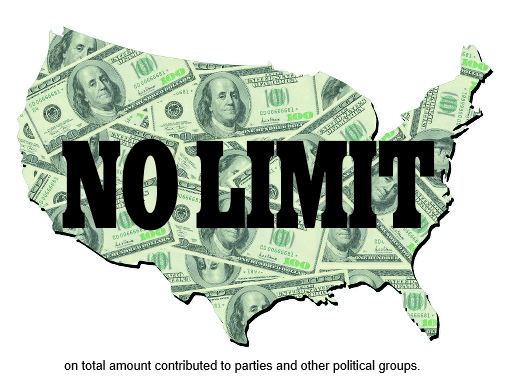
In a nutshell, the Supreme Court just permitted individuals — those who can afford to do so, at any rate — to dole out up to $5.9 million per election cycle to political candidates and parties.
Until today, the limit was $123,000.
So Citizens United allowed Big Business to spend literally as much as it wants — predominantly in undisclosed contributions filtered through the likes of Karl Rove’s Crossroads GPS and the U.S. Chamber of Commerce — distorting our elections. And it allowed billionaires like the Koch Brothers and Sheldon Adelson to funnel unlimited sums through super PACs and other “dark money” conduits.
Now McCutcheon removes meaningful restraints on direct giving to candidates. After today, really wealthy people can write a single check for almost $6 million to party leaders — who will in turn filter the funds to candidates and committees — to elect people who will do their bidding.
Yes, you and I now have this “right” too.
But do you have $6 million lying around?
There are literally only a few hundred people who can and will take advantage of this horrendous ruling. But those are exactly the people our elected officials will now be answering to.
That is not democracy.
It is plutocracy.
But no matter what five Supreme Court justices say, the First Amendment was never intended to provide a giant megaphone for the wealthiest to use to shout down the rest of us.
This is the time for everyone who cares about the fate of our country to mobilize.
We couldn’t face a starker choice:
Accept rule by the few, based on wealth. Or join together to protect and reclaim our democracy — the notion that We the People decide.
The New York Times article
Supreme Court Strikes Down Overall Political Donation Cap
WASHINGTON — The Supreme Court on Wednesday continued its abolition of limits on election spending, striking down a decades-old cap on the total amount any individual can contribute to federal candidates in a two-year election cycle.
The ruling, issued near the start of a campaign season, will very likely increase the role money plays in American politics.
The 5-to-4 decision, with the court’s more conservative members in the majority, echoed Citizens United, the 2010 decision that struck down limits on independent campaign spending by corporations and unions.
Wednesday’s decision seemed to alter campaign finance law in subtle but important ways, notably by limiting how the government can justify laws said to restrict the exercise of First Amendment rights in the form of campaign contributions.
Click her to continue reading The New York Times article.
The best justice money can buy! Lots of money buys a nation.
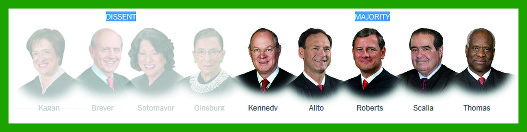 Struck down aggregate limits on contributions from individuals to federal candidates and political party committees.
McCutcheon v. Federal Election Commission
Politico
Supreme Court strikes down aggregate campaign giving limits
The Supreme Court on Wednesday delivered another blow to already rickety limits on campaign contributions, ruling that caps on the total amount of money an individual can give to political campaigns, PACs and parties are unconstitutional.
In the 5-4 ruling, the court’s Republican-appointed justices joined in overturning the so-called aggregate limits on the grounds that they violated the First Amendment, while the Democratic appointees dissented — insisting that the caps were constitutional as a means to guard against corruption and circumvention of the still-valid limits on donations to individual campaigns and political committees.
 Columbia news, views & reviews