
There’s considerable squawking and chatter going on at some facebook sites, at council meetings and around town about how the Market House ought to be and what kind of stand holders and vendors ought to be in the Market House.
Here are some facts taken from verifiable sources.
When the Borough applied for a grant to re-do the Market House, here’s what was stated in that grant application:
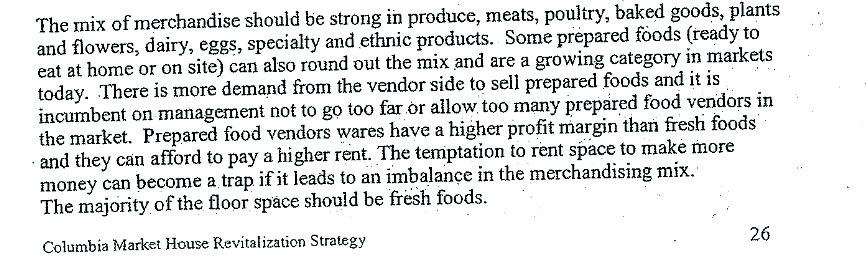 Also the need for an integrated community plan was stated on the page before that.

And there is a need to scrutinize stand holders to insure the integrity of the vendor mix:

The Columbia Borough Website says this:
“According to a national study, the prices in farmers markets are generally lower and the products freshness and nutritional value much higher than for the same items in a typical supermarket. Surveys have determined that market prices on similar items represent an average savings in the range of 8-34%. Today, very little of a customer’s ‘supermarket dollar’ is spent on the food itself. More than $0.79 of every supermarket dollar spent by shoppers goes toward the costs of advertising, management, and overhead – less than $0.21 is returned to the farmer. It is no wonder that public markets can offer both lower prices and better quality produce.
“For lower income households, food costs are even more significant than for other economic strata: among households with an after tax income between $5,000-$10,000,
food expenditures represents approximately more than one-third of their income. The federal government currently funds two program’s which provide fresh, local produce at low or no cost to qualified families (through WIC) and senior citizens (through the Seniors Farmers Market Nutrition Pilot Program). By helping to keep local dollars in the regional economy. Columbia’s Market will strengthen local agriculture, as it adds to local urban investment.
“Not only are these tourists looking for authentic sites such as the Market House, but also revitalization of the Market House will tie in well with the LYHR theme of ‘Foodways – from Farm to Table.’ By incorporating interpretive materials on these themes – such as displays, maps, tasting, and demonstrations – the Market could fill a niche which other regional markets are not currently addressing.
“In dozens of communities across the country, people are re-discovering the value in fresh local foods and community enterprise. Many markets have been started in the past decade, some as simple as parking lot events (like one in Mount Joy) and others in brand new, single purpose buildings (like in Portland, Maine). According to the USDA, the number of farmers markets in the United States has grown dramatically, increasing 79 percent from 1994 to 2002. The 2002 National Farmers Market Directory lists over 3,100 farmers markets are operating in the United States.
“Fresh foods provide important health benefits and two federal agencies recently launched the ‘Five a Day For Better Health’ program. The Departments of Agriculture and Health and Human Services are now developing initiatives to raise awareness of the health benefits of eating more fruits and vegetables. Public Markets are ideal avenues for bringing quality produce closer to consumers.”
 Columbia news, views & reviews
This is an excellent article. Did you know that well over 60% of Pennsylvania’s produce is exported to other states? When you buy food in a supermarket, most of it is not local, with the majority from California, Mexico and other states and countries. You have no idea when it was harvested, how many times it has been refrigerated and how often it has been transported in unrefrigerated trucks and other means of transportation. It certainly is not fresh. Experts will tell you that the best food to eat is that which has come directly from the local farm fields. Also, when farmers sell their produce, milk, eggs, animals, etc., to wholesalers, they do not benefit from the prices the wholesalers give them. Then the wholesalers sell to supermarkets at higher prices, and then the supermarkets set retail prices, the price you pay, even higher. So, it makes sense to buy direct from the local farmers, so they will benefit the most. That also keeps are money in the community and builds our local economy. In addition, farming is extremely hard work, and many farmers stop doing it once they realize how little they make.
So please buy the fresh foods you can get from the Market House and enjoy the healthy benefits you will receive from it. Remember, big agriculture does NOT want you to do this.