Memorial Day, originally called Decoration Day, is a day of remembrance for those who have died in service of the United States of America.
“It’s not Veterans Day. It’s not military appreciation day. Don’t thank me for my service. Please don’t thank me for my service. It’s take the time to pay homage to the men and women who died while wearing the cloth of this nation you’re so freely enjoying today, day.”
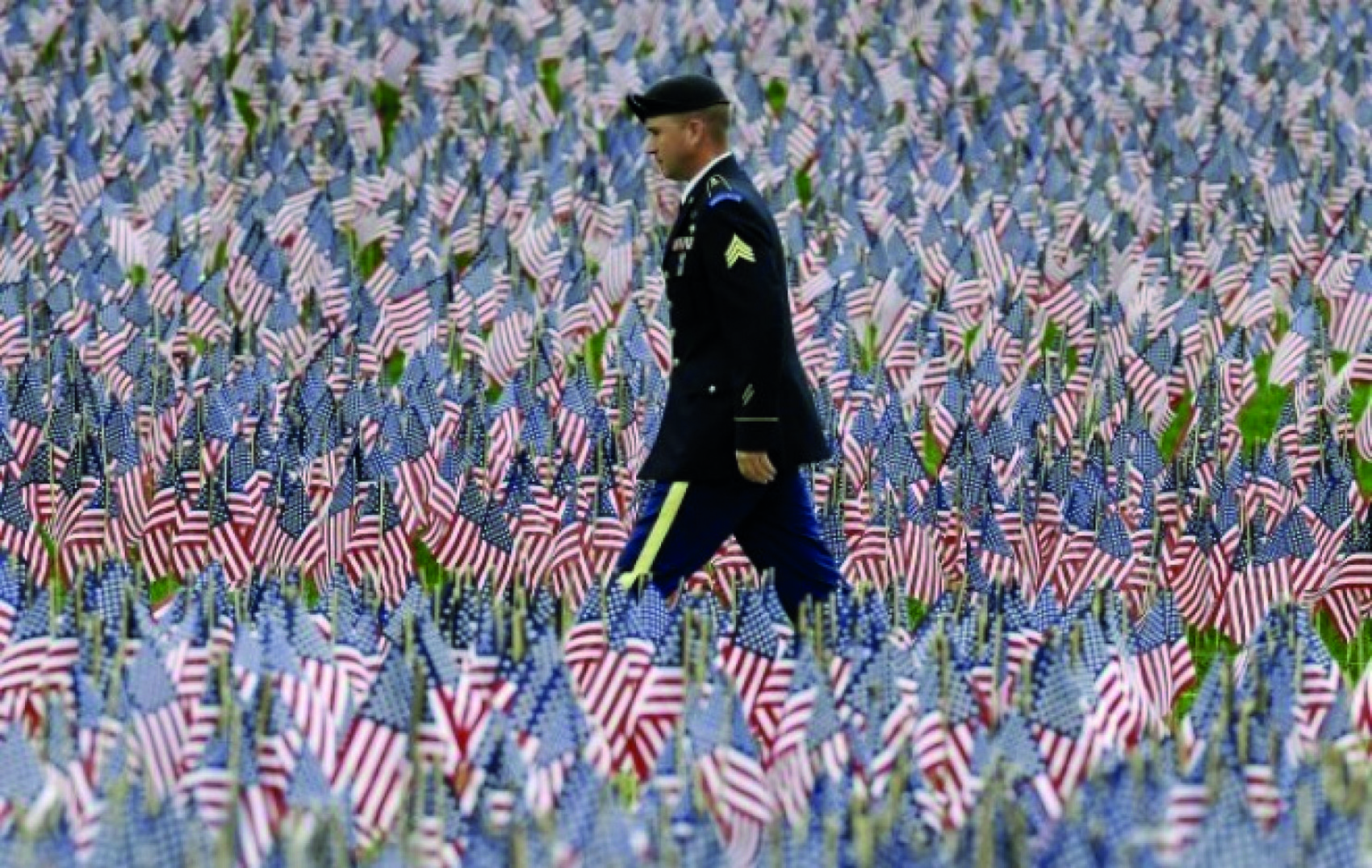
A U.S. soldier walks on a path through the Massachusetts Military Heroes Fund flag garden on Boston Common in Boston on Thursday, ahead of Memorial Day. Each of the approximately 37,000 flags represents a Massachusetts service member who has died. (AP Photo/Michael Dwyer)
Veteran Jennie Haskamp’s article in The Washington Post is pointed and definitive. Veterans know that Memorial Day is a day that remembers those who died in the military service of the United States. It’s a slap in the face when empty politicos, who could have been warriors – but chose another path – pontificate with fake sincerity about the glory of war. They don’t know.
She writes: “I’m frustrated by Memorial Day. And I’m angry about apathy. I want to see people besides the small percentage of us who are veterans, know veterans, love veterans or lost veterans, understand what the day is about. It’s the one day on the American calendar meant to exemplify what it costs to be American and to be free… and we’ve turned it into a day off work, a tent sale and a keg of beer.”
PBI – Poor Bloody Infantry
“We weren’t heroes. We didn’t want to be there. We were scared, we all were, all the time. Any man who tells you he wasn’t is a damn liar. Life in the trenches was dirty, lousy and unsanitary. The barrages that proceeded battle were one long nightmare and when you went over the top it was just mud, more mud mixed with blood and you struggled through it with dead bodies all around you, any one of whom could have been me.”
A British solider, Harry Patch, “the last Tommie” who died aged 111 in 2009 “criticized the politicians for suggesting a commemorative service that year for the survivors of World War One. He wrote: ‘What for? It was too late, too late. Why didn’t we think of doing something for the boys when they came back from the war bloodied and broken? It was easy to forget about them because for years after they never spoke about the horrors they experienced.’”
Seems that the politicians always want to wave their own flags at the side of the warriors.
Read this Cynthia Tucker column too: Honor military by avoiding unnecessary wars. She says, “The best way to honor their service is to refrain from sending them recklessly to war.”
But if our politicos refrain from sending them recklessly to war, who will be the Customers for the war material manufacturing machine and the politicos they control?
What would non-veteran politicians do on holidays that honor military service and veterans?
 Columbia news, views & reviews
Here is a poem by the English poet Wilfred Owen, who died in WWI in 1918 at the age of 25:
Dulce et Decorum Est
Bent double, like old beggars under sacks,
knock-kneed, coughing like hags, we cursed through sludge,
till on the haunting flares we turned our backs,
and toward our distant rest began to trudge.
Men marched asleep. Many had lost their boots,
but limped on, blood-shod. All went lame, all blind;
drunk with fatigue; deaf even to the hoots
of gas-shells dropping softly behind.
Gas! Gas! Quick, boys!–An ecstasy of fumbling,
fitting the clumsy helmets just in time,
but someone still was yelling out and stumbling
and flound’ring like a man in fire or lime.
Dim through the misty panes and thick green light,
as under a green sea, I saw him drowning.
In all my dreams before my helpless sight
he plunges at me, guttering, choking, drowning.
If in some smothering dreams, you too could pace
behind the wagon that we flung him in,
and watch the white eyes wilting in his face,
his hanging face, like a devil’s sick of sin,
if you could hear, at every jolt, the blood
come gargling from the froth-corrupted lungs
bitten at the curd
of vile, incurable sores on innocent tongues,–
My friend, you would not tell with such high zest
to children ardent for some desperate glory,
The old lie: Duce et decorum est
Pro patria mori.
Thank you, Rich … Dulce et decorum est pro patria mori – it is sweet and right to die for your country.
And Napoleon said this: “A soldier will fight long and hard for a bit of colored ribbon.”
And Homer said, “The difficulty is not so great to die for a friend, as to find a friend worth dying for.”
And we hasten to acknowledge the vision of William Tecumseh Sherman, who said, “I am tired and sick of war. Its glory is all moonshine. It is only those who have neither fired a shot nor heard the shrieks and groans of the wounded who cry aloud for blood, for vengeance, for desolation. War is hell.”
Those are excellent words, Brian. Below are some more:
“I believe war is a weapon of persons without personal power, that is to say, the power to reason, the power to persuade, from a position of morality and integrity; and that to go to war with an enemy who is weaker than you is to admit you possess no resources within yourself to bring to bear on your fate.” – Alice Walker
“Half the world is composed of people who have something to say and can’t, and the other half who have nothing to say and keep on saying it.” – Robert Frost
“When the power of love overcomes the love of power, the world will know peace.” – Jimi Hendrix
“The enemy is fear. We think it is hate, but it is fear.” – Mohanes GAndhi
“Fear is the cheapest room in the house. I would like to see you in better living quarters.” – Hafiz
“If absence from repression is the archetype of freedom, then civilization is the struggle against this freedom.” – Herbert Marcuxe
“We build too many walls and not enough bridges.” – Sir Isaac Newton
“The secret of FREEDOM lies in educating people, whereas the secret of TYRANNY is in keeping them ignorant.” – Maximillien Robespierre
“I think fear does two amazing things; maybe they are just aspects of one thing. First, it creates the impression that a person is facing a god, usually a god of war or god of violence; fear makes the adversary look superhuman. Secondly, it creates a new psyche in one’s self – a very disrupted, distracted, terrorized person, the opposite of a stable, self-aware person. Two aspects, one fear. If one’s soul is so enslaved as to bow to the god, one is already destroyed.” – Daniel Berrigan from The Raft is Not the Shore
I respect Jimi Hendrix’s views; he served with the 101 Airborne Division.