It’s right there on the borough Website: “Special Joint Meeting of Columbia Municipal Authority and Borough Council, Monday, July 6, 2015 6 pm to consider approval of an Alternative and Clean Energy Program Digester Project .”
The published legal notice says a bit more: “Notice is hereby given that a Joint Special Meeting of Columbia Borough Council and Columbia Municipal Authority will be held on Monday, July 6, 2015 at 6:00 p.m. in the Borough Hall, 308 Locust Street, Columbia, PA to consider approval of an Alternative and Clean Energy Program Digester Project and any other necessary Borough and/or Authority business. If you are a person with a disability wishing to attend and require an accommodation to participate in the meeting, please contact the Borough Office at 717-684-2467. Georgianna Schreck Assistant Secretary/ Treasurer.”
A couple months ago, a Lancaster Online article noted that Columbia Borough would be the first in the state to have one like this and would be eligible for a “$1,449,952 loan and a $300,000 grant” to build an “anaerobic digester at its wastewater treatment plant that would use food waste, delivered by truck from area food-processing plants and other sources.”
This Website, though, shows three Pennsylvania municipalities operating “Biogas Conditioning Systems.”
What is a Digester? The American Biogas Council explains “How bio-gas systems work.”
Well, digesters are big with dairy farmers, especially since the commonwealth rolled out a grant and low-interest loan program. Dairies, too, have readily available raw materials needed to digest. Cow poop, and pig poop, it appears produce significant amounts of methane, and “Methane is both a potent greenhouse gas and a valuable source of energy,” according to this federal government report.
“Pennsylvania has 30 dairy digesters, including the one shown at Oregon Dairy, as well as around 5 swine digesters. About 10 of those have been installed since 2010.” – biocycle.net
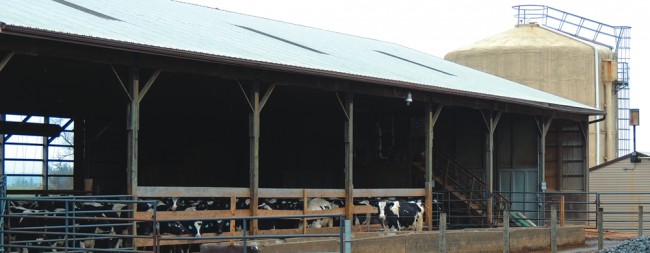
According to a 2011 Department of Community and Economic Development news release, “These projects also will have a positive effect on the communities surrounding them by diverting waste from landfills to be used as organic fertilizers, and reducing the consumption of electricity from the power grid.” DCED’s Alternative and Clean Energy Program details are listed here.
The same news release revealed, “Yippee Farms will receive $1.1 million in grants and loans from the Alternative and Clean Energy program for the purchase and installation of an anaerobic digester that will produce biogas from manure and food waste to generate electricity at its dairy farm in Rapho Township, Lancaster County. The digester will provide annual energy production of 3,354,762 kWh, exceeding the farm’s current electrical consumption of approximately 1,200,000 kWh. The total project cost is $2.2 million.”
Obstacles to Further Development or Deployment of Anaerobic Digesters
Reliability
“Controlled anaerobic digestion requires sustaining somewhat delicate microbial ecosystems. Digesters must be kept at certain temperatures to produce biogas, and the introduction of inorganic or non-digestible waste can damage systems. Performance issues with agricultural digesters in the 1980’s stalled their development and damaged their reputation amongst farmers. Improvements have been made to the current generation of digesters, but questions about long-term reliability still remain.”
Investment uncertainty
“Installation, siting, and the operation of digesters remain costly. When biogas is utilized for energy, agricultural digesters have a payback period of around 3 to 7 years; WWTP digesters have a payback period of less than 3 years, and less if food wastes are also accepted as co-digestion fuel. Financial incentives have helped to catalyze the development of digesters with longer payback periods, but uncertainty about long-term support for digester projects, in the form of tax incentives or subsidies, has impeded development.”
Interconnection with the electricity grid
“While the Energy Policy Act of 2005 required net metering (the ability for electricity consumers to sell electricity generated on-site back to a utility) to be offered to consumers upon request in every state, disparate policy implementation and electricity rates have hindered wide-scale adoption of anaerobic digesters for electricity generation from agricultural sources. California, for example, does not allow utility providers to apply standby charges, minimum monthly charges, or interconnection fees, but utility providers do not buy back excess electricity, leading many farmers to burn-off excess gas rather than to provide the utilities with free energy to the grid. Further hindering adoption are varying limits on the amount of electricity that may be sold back to the grid under net metering rules. The situation should improve as electricity providers gain experience in incorporating anaerobic digesters into the electrical grid.”
There can be personal safety hazards, too. This Penn State report states, “Anaerobic digestion systems and associated manure storage and handling present many safety hazards.”
Ontario’s Ministry of Agriculture, Food and Rural Affairs’ Website has a great deal more about Anaerobic Digestion Basics.
Guess you’ll have to come to tonight’s joint meeting to get all the poop and more answers about the “$1,449,952 loan and a $300,000 grant“ and the intended particulars.
 Columbia news, views & reviews
Anaerobic digestion is a very good step forward. “Cow poop” is one of the biggest producers of methane in the world. Together with carbon dioxide, methane is one of the largest causes of what is being called climate change. Educating the public about anaerobic digestion is a must. Let us hope that the public meeting tonight will bring out a lot of people.
On another note, in the announcements for the meeting, “Special Joint Meeting of Columbia Municipal Authority and Borough Council, Monday, July 6, 2015 6 pm” and in the “legal notice,” there should be a comma after “2015.” I can hear you now, “picky, picky,” but it is proper English.
I hope you all come out to the meeting tonight.
Lol. I make mistakes all the time.
Wise man say, haste makes waste.
Your very clever and observant Richard.
Love it