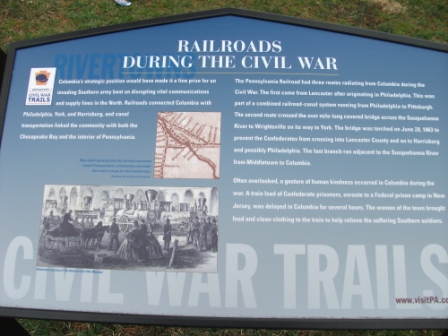
Train enthusiasts can find watching the trains come through Columbia a relaxing experience. As the trains pass through town at a slow pace, it affords lots to time to observe and take pictures or videos. Railroads have played a part in Columbia’s history since the mid-nineteenth century.

Today, the trains pass at a less frequent schedule; Norfolk Southern is the predominant carrier. This picture shows a Norfolk Southern train pacing through last week.

Here is a “train passing through” video posted at youtube: http://www.youtube.com/watch?v=a93SlVO05qs
A http://www.google.com/ search generated this timeline of historic nineteenth century dates in Columbia concerning railroad history:
1823 – Mr. Scott was born December 28, 1823, at London, Franklin County, Pennsylvania. He was first regularly employed by Major James Patton, the collector of tolls on the state road between Philadelphia and Columbia, Pennsylvania. He entered into the employ of …THOMAS ALEXANDER SCOTT. —This name is indissolubly connected with the history and development of the railway systems of the United States. He was first regularly employed by Major James Patton, the collector of tolls on the state road between Philadelphia and Columbia, Pennsylvania.
1832 – The Pennsylvania Railroad, begun as the Columbia Railroad, was started in 1832. Its development also was swift. It branched into the western part of the State, carrying freight by means of a gigantic network of lines to Philadelphia.
1834 – On October 7, 1834, the line that would become the heart of the giant Pennsylvania Railroad’s system was officially opened. At 8:00 that morning, two trains left Columbia, on the Susquehanna River, carrying Pennsylvania’s governor George Wolf and various state officials and guests. Locomotives named the Lancaster and the Columbia pulled the cars all day and finally brought them to Philadelphia around 6:00 in the evening.
1852 – “The red- letter day was December 10, 1852, when the first through train from Philadelphia to Pittsburgh was operated over the Philadelphia and Columbia Railroad, the Pennsylvania Railroad, and the Allegheny Portage Railroad.” “The red- letter day was December 10, 1852, when the first through train from Philadelphia to Pittsburgh was operated over the Philadelphia and Columbia Railroad, the Pennsylvania Railroad, and the Allegheny Portage Railroad.” Some consider this event was as important to the development of Pennsylvania as the meeting of the Union Pacific and Central Pacific railroads at Promontory Point in Utah was to the development of the United States.
1857 – The offer was not accepted, but on June 25, 1857, the whole of the property was sold at auction to the Pennsylvania Railroad Company for the sum previously offered. On the first of August following the Pennsylvania Railroad Company took possession of the …On the first of August following the Pennsylvania Railroad Company took possession of the property, including the Philadelphia & Columbia Railroad, and the reign of politicians as railroad officials terminated.
1890 – The two railroad companies aforesaid, namely, the Columbia and Port Deposit Railway Company of Pennsylvania, and the Port Deposit Railroad Company of Maryland, were consolidated May 29, 1890, under the name, style, and title of the Columbia and Port …The two railroad companies aforesaid, namely, the Columbia and Port Deposit Railway Company of Pennsylvania, and the Port Deposit Railroad Company of Maryland, were consolidated May 29, 1890, under the name, style, and title of the Columbia and Port Deposit Railway Company, under the laws of the Commonwealth of Pennsylvania and the State of Maryland.
Columbia’s railroad – Reading and Columbia Railroad
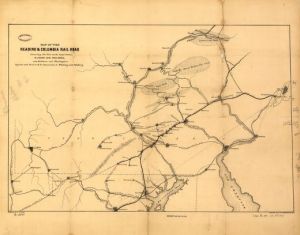
We extracted this from an 1862 letter to the editor of the New York Times: “The facts are that the Reading and Columbia Road runs along a most beautiful valley, through farms of the highest state of cultivation, and worth from $150 to $200 per acre, with the exception of about two miles where the road crosses Blue Ridge.”
And here is a history of the Reading and Columbia Railroad:
“The history of the Reading & Columbia Rail Road started with the Philadelphia & Reading Railroad Company chartered April 4, 1833 by an Act of the Pennsylvania Legislature. This is all part of a complex story that began locally in 1857 with generated interest in a railroad between Reading and Columbia. A group of influential citizens from Lancaster and Berks Counties secured passage of a charter creating the Reading & Columbia Rail Road Company, which was signed by Governor James Pollock on May 19, 1857. By December, 1860, the survey and location of the R. & C. route was completed. It was decided that Sinking Spring, where a connection could be made with the Lebanon Valley Railroad, would be the starting point, and the line would run by the way of Reinholds, Stevens, Ephrata, Akron, Millway, Rothsville, Lititz, Manheim, Landisville and onto Columbia, a distance of 39.8 miles. Although the major construction was started at the Columbia end of the line, the actual ground breaking for the R. & C. was done on March 28, 1861, at a gap in the South Mountains about 4 miles south of Sinking Spring. The first Lititz passenger depot and express station was located on the north side of the tracks along Broad Street, which is the present site of Wilbur Chocolate Company. The depot was dedicated December 26, 1863, with the arrival of the first passenger train. Ceremonies began with a welcome speech by John Beck Headmaster of the Boys’ School. Mr. Beck was answered by a pompous railroad official making a speech about prosperity and the hope for peaceful future. Bishop Edmund A. deSchweinitz, of the Lititz Moravian Congregation, offered a prayer of dedicating the Reading & Columbia Rail Road to a promise of progress for Lititz and the surrounding countryside. Following the completion of the railroad between Columbia and Sinking Spring, a special train carrying officials and invited guests made the first trip from Columbia to Reading on March 15, 1864. A morning train from Reading and an afternoon train from Columbia inaugurated the first regular passenger train schedule between Columbia and Reading on April 1, 1864. On March 8, 1884, the Lititz Moravian Congregation leased a parcel of land two hundred feet by thirty feet, situated on the northwest corner of the Lititz Springs Park grounds, to the Reading & Columbia Rail Road Company for a term of 999 years. A passenger depot in “Victorian Gothic” architecture designed by Frank Furness of Philadelphia was erected. (Bricks used in the construction of the depot were manufactured in Lititz.) At the same time two bridges were built across the Lititz Creek, one to enter the depot and park grounds and the other to obliterate the ford on Broad Street. On Monday, December 1, 1884, the new red brick depot and express station was opened to the public. Six passenger trains a day would stop at Lititz during their route to Reading or Columbia. Extra revenue was earned by the subsidized mail and railway express items that the trains carried. D. E. Light was the ticket agent and operator and J. T. Zell was the freight agent. Heavy industry arrived in Lititz by 1899, the same year street cars ran for the first time to the R. & C. Depot. Also, because of the depot, the annual Fourth of July celebrations in the Park attracted more and more people. In 1919, it was decided to renovate the 1884 depot by adding a freight house and moving the platform to the east side of the depot. This was never done, however, because of needed space for freight operations, a freight house and office was built in 1921 along S. Water Street, by the Hershey & Lehman Company of Lititz. By now, the Philadelphia & Reading Company, which operated the R. & C., was merged with the Reading Company in 1923. The Reading Company assumed the operation of the Reading & Columbia Rail Road, but the R. & C. still retained its corporate existence. It was not until December 31, 1945 that the Reading & Columbia Rail Road Company was merged with the Reading Company after which the R. & C. as a corporate identity ceased to exist. Upon the demise of passenger service, the Reading Company no longer required the passenger depot erected on the land leased from the Lititz Moravian Congregation. On August 24, 1953, the 999 year Agreement of Lease was terminated. The last complete passenger train to pass through Lititz was on October 28, 1952, at 11:11 a.m.; a special train carrying presidential candidate Adlai E. Stevenson. The 1863 depot was demolished for the building of the Ideal Cocoa & Chocolate Company factory (now Wilbur Chocolate Company); and the 1884 passenger depot and freight station was demolished in May of 1957 to make way for construction of a modern entrance to Lititz Springs Park through the generosity of Elmer H. Bobst, who provided $100,000. for improvements to the Park. On April 1, 1976, the bankrupt Reading Company ceased being an operating railroad ending 143 years of railroading.The “Golden Era” of the Reading & Columbia Rail Road is gone, but a certain spirit feeling of the “good old days” will continue to linger on in the years to come, especially with the construction and dedication on May 8, 1999 for the replica of the 1884 Lititz Passenger Depot and Express Station on the same northwest corner within Lititz Springs Park. R. Ronald Reedy Lititz Springs Park Historian.” SOURCE: http://davecathell.tripod.com/col.html
Come to Columbia – see the history; watch the trains in Columbia!
 Columbia news, views & reviews

Thanks for the article I actually learned one thing from it. Very good content.