The following article appeared in the Lancaster Intelligencer Journal/New Era on Tuesday, October 4, 2011.
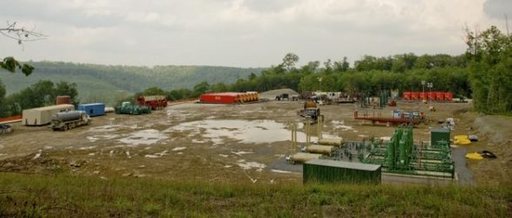
Joshua Pribanic / Eriewire.org Marcellus shale gas comes to State Game Lands 59 in Potter County.
It was written by Ad Crable, the outdoors writer for the Lancaster newspapers.
There is a spot overlooking a ravine in Tiadaghton State Forest where Bob Kutz was taken by his father when he began deer hunting. Kutz’s father had been shown the special place by Kutz’s grandfather.
Kutz, 68, of East Hempfield Township, has taken some 20 deer and a few turkeys from that area.
It became a familiar friend, a place he could go year after year and, during the peaceful interludes of still hunting, flip through an ever-expanding patina of memories.
Then, last year, a 70-yard-wide clearcut was punched through Kutz’s honey hole for a Marcellus shale natural gas pipeline.
“It’s a little sad for me,” Kutz says. “I remember as a kid how I used to look forward to that spot and now I have to hunt from the perimeter. It’s just not quite the same.”
To add insult to injury, a couple weeks ago Kutz was attending a meeting about Marcellus shale and the need to protect mountain waterways. The speaker flipped up a slide showing planned Marcellus shale wells in the Slate Run area of Lycoming County.
Two dots, signifying well pads, were superimposed right over Kutz’s favorite hunting spot.
Kutz hadn’t been up to his 17th Ward Hunting Camp this summer. For all he knows, the woods already are undergoing major changes. He worries about what he will find in a few weeks when turkey season opens.
Partly because of significant and expanding natural gas drilling spreading across public and private lands, and partly because of nature’s fury in recent months, the Pennsylvania Game Commission last week urged hunters to be sure to do preseason scouting.
“There have been a number of dramatic changes in the landscape,” the commission warned.
“The ‘Big Woods’ area of northcentral Pennsylvania, home to many of the traditional hunting camps, lies within the area being explored for Marcellus shale natural gas, and has seen a dramatic increase in drilling,” Carl Roe, the agency’s executive director, said in a press release.
“Northeastern Pennsylvania also has seen a large volume of Marcellus shale activity. Both of these regions experienced more disruption of traditional hunting and trapping areas from drilling activity.”
Drilling pads, equipment and water storage areas, as well as pipeline swaths and access roads can rapidly and significantly alter the hunting grounds of hunters.
Moreover, flooding and wind damage from Hurricane Irene and Tropical Storm Lee has caused a lot of damage to back roads and bridges.
Storm damage and roadways used for gas drilling may force hunters and trappers to use alternate routes to reach hunting spots.
“We may have some areas normally open to vehicles that will need to be closed this year until repairs can be made,” says Jerry Feaser, commission spokesman.
The state Bureau of Forestry issued an advisory on Sept. 13 saying that most roads in Loyalsock State Forest were not passable. Still, plans had been made to open to archery hunters 442 miles of state forest roads that are normally only open for administrative use.
To check current conditions on the roads in state forests, call the Resource Management Center at 570-946-4049 or e-mail fd20@state.pa.us.
Since 2008, the commission has leased thousands of acres of game lands for Marcellus shale drilling.
On land in which the agency owns the mineral rights, the agency can set ground rules for drillers.
It is required, among other things, that no drilling-related activities occur on the opening day of archery season, the opening day of any youth or special-use hunting season, the opening day of early fall muzzleloader deer season, the opening day of the early and general small game seasons, the first three days of the antlered and antlerless or concurrent antler/antlerless firearms deer season, the fall turkey season opener, all Saturdays of firearms deer season, the opening of the spring turkey season and opening day of bear season.
And the agency doesn’t allow disturbance in sensitive areas such as wetlands, important mammal areas and where threatened or endangered species have been found.
However, the commission only owns the mineral rights on about half the game lands. Where private parties own the subsurface rights, the commission can only ask that activities be curtailed during those hunting times.
Do they generally comply with requests to think of hunters? “We ask but they don’t always agree,” replies Feaser.
In addition, the agency only has so much sway in controlling landscape changes on game lands from those who control the mineral rights below the game lands.
According to law, mineral and gas owners have the right to “use the surface in a reasonable manner to access these natural resources.”
Again, Feaser says the agency tries to minimize disturbance, but not always with success.
Still, there are those who believe landscape changes in the short-term will mean better hunting down the road.
Former Game Commissioner Stephen Mohr of Bainbridge remembers the complaints and concerns that rained down during the shallow gas boom of the 1950s.
Those clearings and plantings then “may have been the biggest blessing for wildlife and hunting since the days of the great timbering movement,” says Mohr, referring to the habitat that grew up.
Mohr thinks that, in a few years, when the rigs are moved and the areas seeded and planted, a wildlife bonanza may be at hand, especially for deer and turkeys.
Jerry Chase, 63, of Lititz, suggests hunters rousted from familiar hunting grounds simply scout for new feeding and bedding areas.
“Move 300 yards. It’s not the end of the world — and we need the gas,” he says.
But Kutz would rather have intact woods and the mast they produce. He says he hasn’t seen clearcuts adding much to the deer population in his neck of the woods.
The commission says the disruption of game lands is paying dividends for hunters and trappers in other ways.
The Marcellus shale money is allowing the commission to do things it hasn’t for years. For example, gas money made possible the addition of 9,300 acres to game lands in Clearfield County. Last year, in exchange for a gas lease, CNX Gas gave the commission 2,300 acres in Indiana County.
Much of the payments and rental money from Marcellus shale goes toward expanding the state’s prized game lands system.
Says Feaser, “The short-term loss of land through Marcellus will be made up as these areas return to huntable/trappable lands, as well as the new lands.”
acrable@lnpnews.com
 Columbia news, views & reviews