In 1983, a consortium of concerned citizens filed a “nomination form” application to the United States Department of Interior, National Parks Service, National Register of Historic Places Inventory to have “an irregular 22 block area … inclusion in the National Register and certify that it has been evaluated according to the criteria and procedures set forth by the National Park Service.”
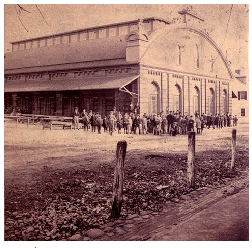
Very early photo of Market House, not from 1983.
“Columbia Historic District is important because it illustrates two centuries of the town’s growth and development as a key transportation and industrial center in south-central Pennsylvania. Starting with the establishment of Wrights Ferry in 1730, Columbia served as a: key to river, canal, rail and road travel, and as a result, the Community developed transshipment and industrial facilities to capitalize on the relatively easy access to major urban areas & markets.
“In addition, from its earliest settlements, Columbia and its leaders aided & influenced settlement & emigrations to adjacent York County & beyond. The district is also important for its well preserved 18th, 19th, & .20th century architecture, the high quality of which reflects Columbia’s prosperity & prominence.”
“Situated on the eastern bank of the Susquehanna River, amid rich farm county, Columbia occupies a gently sloping landscape where the river widens to, almost a mile’s breadth presenting a peaceful lake-like appearance dotted by small islands, The harmony is broken by the busy traffic of the two bridges spanning the river.
“The Columbia Historic District takes in approximately 950, structures spread over an area that incorporates about one ,third of the borough, ”’Old Columbia” with its extensions, additions and continuations is included, The building types are divided between residential, commercial, industrial, civic & ecclesiastical, in styles that range from Eighteenth, Century ,Traditional to Queen Anne & Twentieth Century Art Deco.
“Only the esoteric styles such as Egyptian Revival and Art Nouveau were eschewed by the community’s leaders, Remarkably, a high percentage of these structures remain intact or altered only superficially, Row upon row of houses facades in either the Greek Revival, Italianate, Mansardic or Colonial Revival manner stand without interruption or intrusion.
“Generally speaking, if they are sided by factories, warehouses or commercial establishments, it is because they have always been so.
Back in the late 1980’s, we owned a house on Chestnut Street which was described in this report as: “Gothic Vernacular – 2 1/2 story, 2 bay brick with simple brick detailing. Dominated by a central gable housing a Gothic arched window and enlivened by an angled bay within the full, first story porch.”
Columbia Historic Market House
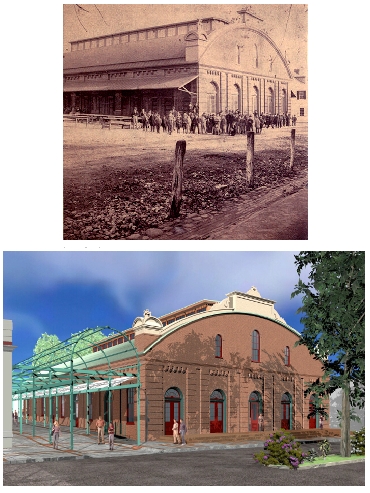
The Columbia Market House was described as: “Building – Constructed of locally made brick, the structure has functioned as a market house since its erection in 1869. The Hobbsian facade, modified by W. W. Upp, is characterized by five bays distinguished by paired, rusticated brick piers enframing corbelled blind arches.
“The arches surround monumental double doors headed by deep round-arched, radiating fanlights, in turn, surmounted by simple architraves with raised keystone detail. The doors have large mul tipanes within an elongated upper sash which is based in a square, molded wooden panel.
“A plain banded brick cornice caps off the ground level, separating it from the rounded gable of the vaulted roof above.
Within that gable are three narrow-round headed windows, two smaller ones (4/4) flanking a larger centre one (9/6). The arrangement creates an arch of fenestration.
“Originally, the Corners of the cornice were enriched by thick brick square corner posts headed by round arched panels, with sculpture affixed. The gable, itself, was then embellished by a rectangular cornice block. These decorative elements were removed prior to a recent rehabilitation during which the structure was sandblasted.
“The side elevations are broken into nine bays that mirror the stylizing of the front facade, i.e. round-headed fenestration is contained within corbelled, square-headed blind arches banded by smooth faced brick piers rising out of a slightly projecting water course. To be more explicit, round-headed 9/9 sashed windows resting beneath simple brick arches bearing raising brick keystones alternate with similarly arched doors. The doors are identical to those of the main facade. When constructed, the building had wooden porches on both sides, which provided space for outside vendors. They no longer exist.
“The rear facade repeats the front except for its gable fenestration. Initially, four round-headed windows evenly spaced the brick field with a circular window topping them. Now, both the circular window, and the outer round-headed windows have been bricked in.
“Another alteration is the existing clerestory, which ranges the full length of the originally tinned roof (now asphalt shingled).
“It had large multi-paned windows which lighted the interior below. It has been sided over. The Sloan interior is a large rectangular space, 118 feet by 80 feet, – unbroken by posts or pillars. Instead, eight wooden Howe trusses stabilized by iron rods support the roof. The rods join the trusses at the juncture of three foot wide brick pilaster engaged within the unplastered inner walls.
“The Sloan floor plan has been altered to allow for rest rooms and an interior entrance to the “dungeon” area below.
“Original fixtures, market stalls and “Columbia” stoves, provide integrity, imbue the building with the character of a market house and attest to its true nature – a surviving Central Pennsylvania farmers’ market.
“Below, the barrel vaulted partial basement or “dungeon” was originally conceived as a storage space for green grocers and butchers; however, it served as a lock-up for vagrants and felons instead. Its small cells have grated windows allowing fresh air to ventilate their dampness.
“Houses- Two frame houses ‘occupied the site of the market house prior to its erection.”
And where was this property? HINT: It had windows!
“Utilitarian Industrial Vernacular – A set of four integrated buildings. The first section constructed of reinforced concrete and brick has large multiple paned windows with movable center sashes topped by concrete lintels and braced by brick pilasters. The second story windows are deeper than those of the first story. The whole section is capped by a band of concrete into which the pilasters taper. That is crowned by a band of brick edged in concrete.
“Section two is a 4 bay, gable ended brick structure having segmental arched symmetrical fenestration. The center is marked by a three story brick pilaster that tapers into the gable.
“Large 12 over 12 sashed windows flank its sides with one bay on the left deeped for cargo entries. The third addition is a 3 story, a bay addition with irregularly balanced segmental fenestration capped by a 7 bay, 1 story addition with large multi-paned square-headed windows. The fourth section juts from the right side in reinforced concrete and brick.
What was could be
If you go to this website, Community Heritage Partners, you can see more pictures about how the Market House looked, looks and might look like.
If you would like to see other property descriptions, as written in 1983, send us an email, give a call or post a comment with the address.
 Columbia news, views & reviews