by Mary Ellen Graybill
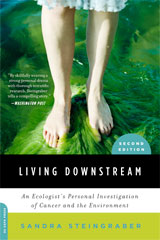
A scientist and poet, Sandra Steingraber, is an eloquent spokesperson on the environmental links to cancer and human health, and she spoke eloquently at F&M College earlier this week. It was an auditorium packed with pizza-eating and apple chewing students, enjoying their “common hour” together, which regularly features speakers and is open to the public. Having seen the film by Josh Fox called “Gasland” recently at both F&M and Millersville University, I decided to attend both free events and am glad I did.
Not only was the pizza delicious, the lecture was eye-opening. Ecologist Sandra is reportedly the first person to bring together data about toxic releases from industry and agriculture using data from U.S. cancer registries with her book, published first in 1997, and called Living Downstream. The second edition (2010) is available at local public libraries now. (I checked and it is available.) The book was made into an impressive, smoothly done film by The People’s Picture Company (Toronto, Canada). Seeing it, you can hear and feel what Steingraber went through in a year of travel across North America lecturing and learning along the way, about her own remission from cancer, with ups and downs along the path even today.
I had already seen the film Living Downstream, in the new auditorium named for Lisa Boncheck Adams ’91 last evening. Both events were introduced by Professor Richard Pepino, environmental professor at the college.
Another book Having Faith: An Ecologist’s Journey to Motherhood tells about the link between the environment and unborn children. Steingraber peppers her descriptions of personal health concerns with unknown and known facts about the connection between pollutants in the air and water and cancer.
Noting the trend to fund genetics as a cause of cancer, instead of funding studies about the environmental sources of the condition, she aims to convince the audience that activists can do something about the situation. After the lecture today, Elaine Esch and others asked poignant questions about what to do in Lancaster County and got some practical advice. For more details, please see this earlier report.
Sandra Steingraber also has a background in literature and poetry. Not only does she write and lecture around the country in a non-stop schedule talking about the factors that have contributed to health problems, she produces poetry about the subject.
But it’s the facts that speak for themselves, and her observations that are making a difference.
Steingraber is saying that media is fast to report on Wall Street stocks and is slow to report on the serious issues of public health. One topic getting more press these days is the bad side effects of the natural gas drilling procedure called “fracturing” (fracking) under the Marcellus Shale running through the Delaware River Basin and ultimately the Susquehanna River also. “Fracturing” is the use of many chemicals (over 500) and gels, and water forced down a straw-like pipe in order to break open the rock that encloses a complete ecological system of living organisms along with methane and natural gas.
Award-winning, Sandra has gotten the Sierra club title as the “new Rachel Carson”- a moniker she has earned from both personal experience of a bout with cancer, and an intellectual determination to spread the word about cause in the environment. (2001 she got the Biennial Rachel Carson leadership Award from Chatham College, Rachel Carson’s alma mater)
In 2008 she got the Doctor of Letters from Lycoming College in Williamsport, PA for her writing (an honorary degree) … and in 2010 is named as one of “25 Visionaries Who Are Changing Your World” by Utne Reader Magazine.
With husband Jeff deCastro an art restoration expert, and her two children, Faith and Elijah, she lives in New York in a 1000 square foot house, with a clothes line and push mower, and vegetable garden.
Living Downstream: An Ecologist Looks at Cancer and the Environment (1997, 2010) covers a connection between the cancer registry date and the “Toxics Release Inventory” data. It’s a timely topic and appropriate for any town situated along a river basin, like the Susquehanna River.
 Columbia news, views & reviews