In the past couple of years some of those “shun” (-tion) words seem to have become more noticeable in life.
 Recognition – Obsession – Expression – Fascination – Desperation – Deterioration – Exploration – Adaptation – Occupation – Revelation.
This is the second in this series of “shun” words – reflective words associated with the realization that “death happens.”
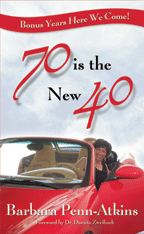
Seldom do people want to deal with reality issues. It seems to be a particular truth when middle age folks begin to realize (as one of my realistic Columbia friends says, “There’s more in the rear-view mirror than in the windshield.”) that they’re not getting younger. There are bunches of sources that claim that age is not a barrier; there’s a collection of people who claim that “70 is the new 40.” In fact, there’s a book entitled just that.
So those in their 50s, 60s and 70s are reaching for the “never gonna’ age brass ring.” They’re joining gyms; taking sex enhancing wonder drugs; planning exotic vacations; undergoing enhancement surgeries and Botox infusions; having age spots removed and denying that “$%it happens.” In fact, author Susan Jacoby, in her 2011 book “Never Say Die,” contends that “the fallacies promoted by twenty-first-century hucksters of longevity – including health gurus claiming that boomers can stay ‘forever young’ if they only live right.”

She agrees that some aging people can maintain a vestige of a more youthful appearance, but that genetics plays a large part in how well people will age. She raises the fundamental question of whether living longer is a “good thing unless it means living better. In the book, Jacoby (herself a 65-ish person) wonders whether there is an illusion of “remaining youthful.” Everyone knows that there are hundreds of drugs to stay age-related issues including elevated cholesterol and blood pressure; impotency; menopause; wrinkles; age spots; knee and hip injuries; memory lapses and other aches and pains associated with the aging process. There is an overwhelming fervor with maintaining “what was,” but increasingly denial of “what was” with diminishing capacity or intensity.
While reading “Never Say Die,” it occurred to me that Jacoby is the boomer generation’s Simon Cowell. Jacoby, Cowell and Kramer are telling folks what they do not want to hear: the truth.
“You can’t sing and your parents and friends are wrong.”
“You’ve got an ugly baby.”
“Age happens; deal with it.”
Jacoby says, “Defying old age (claims, drugs, promises) … fills me with rage, because the proximity of old age to death is not only undefiable but undeniable.”
Joseph Epstein wrote a review of Jacoby’s book for The Wall Street Journal; the review is entitled “Nobody gets out of here alive – You can deny the inevitable but not defy it—still there are a few compensations to growing old.” Epstein says:
“In her book, Ms. Jacoby serves as a reality instructor. Bad news flows from her as profanity from a rap group. And bad news is what she has for all who believe that, because longevity has doubled since the middle of the 19th century—this owing chiefly to improved sanitary and environmental conditions—there is no good reason for its not continuing to climb upward, ever upward. She reports, for example, that of all who attain the stately age of 85, fully half will have that stateliness snuffed out by Alzheimer’s; and, more wretched news, there is a strong chance they will also end up in a nursing home with some other dread medical affliction or other.”
He also reminds readers that the darkness and starkness of “Never Say Die” ought be balanced by the writing of Cicero.
“For all the diminishments of old age Cicero set out accompanying consolations. ‘Great deeds are not done by strength or speed or physique: They are the products of thought, and character, and judgment,’ he argued. ‘And far from diminishing, such qualities actually increase with age.’ The lust of youth is not merely overrated but the seat of much outrage and indecent behavior. ‘When its campaigns of sex, ambition, rivalry, quarrelling, and all other passions are ended, the human spirit returns to live within itself—and is well off.’ He added: ‘The satisfactions of the mind are greater than all the rest.'”
Click here to link to The Wall Street Journal review.
So what happens; “the wheel of aging spins round and round; where it stops – nobody knows!”
by Brian L. Long
 Columbia news, views & reviews