These two baseball stories about baseball’s “10 worst moments” come from Listverse.com. Christy Mathewson and Sandy Koufax are two of the greatest pitchers to ever play, yet both suffered with career-ending maladies. The other eight stories are equally tragic.
Christy Mathewson
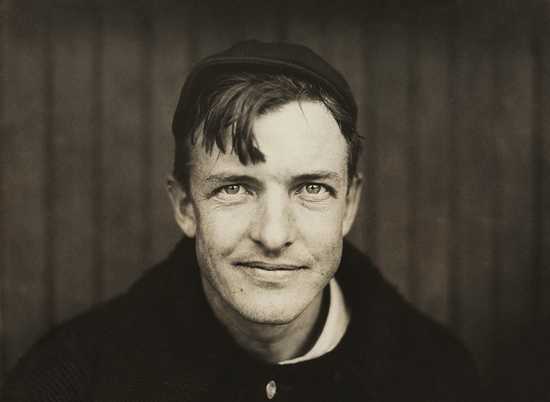
Mathewson was one of the mightiest pitchers in baseball’s history. His whole career fell within the dead ball era, when a single ball was used for the entire game. Such balls were difficult to see after they were covered in infield dirt and tobacco spit (spitballs were legal until 1921). Mathewson was no stranger to the spitball, but he was known as a “control pitcher,” as opposed to a power pitcher like Nolan Ryan. Whereas, Ryan could heave a 100+ mph fastball, he isn’t renowned for his skill at any other pitch, and had quite a few wild ones.
Mathewson, however, could throw strikes with everything. You name it: the 2-seam fast, the 4-seam, the forkball, slider, sinker, curve, knuckle, knuckle-curve, palm, palm-curve, and his money pitch, the screwball, which curves in the opposite direction of the curveball. Mathewson could fling them all right into the strike zone and fan anyone.
Consider that, whereas Nolan Ryan scored the most career strikeouts at 5,714, 839 more than 2nd place, he also scored the most walks with 2,795. Thus he walked about 49% of the batters he faced throughout his career. Mathewson, on the other hand, struck out 2,507 batters, while he walked only 848, which is 33% of them. That’s a gargantuan margin of difference between two greats and serves to show the accuracy of “the Christian Gentleman.”
Unfortunately, he was stolen too early from baseball’s posterity, when, in 1918, he enlisted into WWI as a chemical weapons trainer for the infantry. Ty Cobb and George Sisler also enlisted into the same unit, and the three saw each other frequently in France. As a captain, Mathewson’s job was to oversee the training, in gas chambers, of controlled release of mustard gas amid soldiers wearing their gas masks.
His voice inside the chamber was misunderstood by the gas operator outside as the order to release the gas. Once they heard the hiss, Mathewson first saw to the soldiers’ safety by ordering their masks on immediately. Only then, when milliseconds were precious, did he shout for the gas to be turned off. The operator did so, but there was a delay of more time than Mathewson could hold his breath. One private attempted to remove his mask, but Mathewson, with his eyes shut tight, knowing the sound of a mask being removed or put on, quickly yanked the man’s hands from his face and shouted for him to remain still.
Mathewson finally had to take a breath or risk blacking out. That single breath before the room was purged gave him tuberculosis. He tried coaching for a while when he returned the next year, but had to take frequent vacations for his lungs’ health, before finally retiring in 1921. He died 4 years later at 45 years old. His teammates openly wept at the first game following his death.
Sandy Koufax
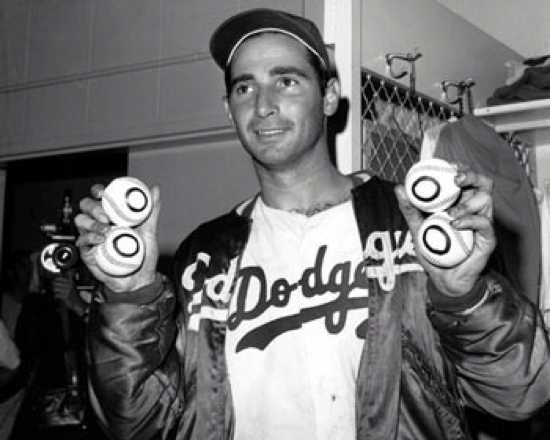
One of the saddest ends to what could have been universally accepted as the greatest pitching career in baseball history was the premature retirement, due to severe arthritis, of Sandy Koufax. He played for 12 years, always for the Brooklyn or Los Angeles Dodgers, and yet after those 12 short years, he had posted 2,396 strikeouts, and a career ERA of only 2.76, second lowest in the history of the live-ball era.
His best seasons were 1965 and 1966. For several years, he was pitching full 9 innings of game after game with horrible pain in his left arm, centered at the elbow. The morning after one of these games, he woke to find his arm black and blue from shoulder to wrist from hemorrhaging. To deal with the pain, he began taking Empiring with codeine every night, and sometimes during a game, Butazolidin, and applying a capsaicin cream to his elbow. After each game, he had to immerse his left arm in a tub of ice.
And still, he went out a pitched another complete game the next day, and again, and again. On 9 September 1965, in spite of his agony, he pitched a perfect game. More people have orbited the Moon than have pitched perfect baseball games. It is defined as no hits, walks, struck batters, or any base reached safely by the opposing team. 27 up, 27 down. Koufax’s perfect game also featured the most strikeouts, 14 out of 27.
His pitches were the stuff of legend. Carl Yastrzemski, who retired with 3,419 hits, remarked that “hitting the curveball off Sandy Koufax was like drinking coffee with a fork.” Koufax threw with a marked over-the-top arm motion, not out to the side. This, along with his extremely strong legs, gave him blazing speed with every pitch. His curveball was clocked at 94 mph. It curved from 12 o’clock to 6 o’clock all within the last half to one-third of the distance to the batter, forcing the batters to swing almost straight up, as if golfing, in order to hit it in its descent.
He threw a four-seam fastball that floated upward up to 4 times before reaching the catcher. All the while, his arm was hurting so badly that he began tipping his pitches, letting the batters know what he was about to throw as he wound up. Nevertheless, as Willie Mays put it, “I knew every pitch he was going to throw and still I couldn’t hit him.”
At the end of 1966, with a 1.73 ERA in the books, he had to call it quits. He couldn’t sleep because of the pain, and considered having his arm amputated. Once he gave up pitching, however, his arm quickly healed. Jeff Torborg, who caught his perfect game, once remarked, “It’s like God came and took his arm back.”
 Columbia news, views & reviews