“The device in your purse or jeans that you think is a cellphone — guess again. It is a tracking device that happens to make calls. Let’s stop calling them phones. They are trackers.
“Most doubts about the principal function of these devices were erased when it was disclosed (last) Monday that cellphone carriers responded 1.3 million times last year to law enforcement requests for call data. That’s not even a complete count, because T-Mobile, one of the largest carriers, refused to reveal its numbers. It appears that millions of cellphone users have been swept up in government surveillance of their calls and where they made them from. Many police agencies don’t obtain a search warrant when requesting location data from carriers.
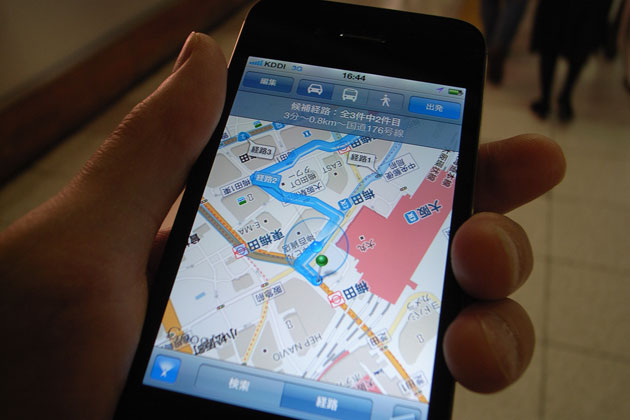 (Flickr/matsuyuki)
“Thanks to the explosion of GPS technology and smartphone apps, these devices are also taking note of what we buy, where and when we buy it, how much money we have in the bank, whom we text and e-mail, what Web sites we visit, how and where we travel, what time we go to sleep and wake up — and more. Much of that data is shared with companies that use it to offer us services they think we want.
“We have all heard about the wonders of frictionless sharing, whereby social networks automatically let our friends know what we are reading or listening to, but what we hear less about is frictionless surveillance. Though we invite some tracking — think of our mapping requests as we try to find a restaurant in a strange part of town — much of it is done without our awareness.
“‘Every year, private companies spend millions of dollars developing new services that track, store and share the words, movements and even the thoughts of their customers,’ writes Paul Ohm, a law professor at the University of Colorado. ‘These invasive services have proved irresistible to consumers, and millions now own sophisticated tracking devices (smartphones) studded with sensors and always connected to the Internet.’
“Mr. Ohm labels them tracking devices. So does Jacob Appelbaum, a developer and spokesman for the Tor project, which allows users to browse the Web anonymously. Scholars have called them minicomputers and robots. Everyone is struggling to find the right tag, because ‘cellphone’ and ‘smartphone’ are inadequate.” To read this ProPublica, which was “co-published with The New York Times,” in its entirety, click here.
 Columbia news, views & reviews