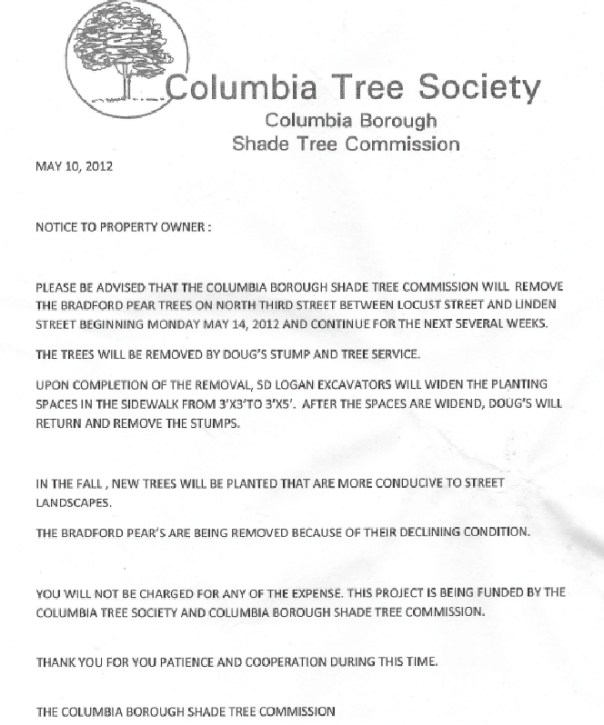
A few days ago, copies of the above notice were hand-delivered to some houses on North Third Street; we say some because some people at some addresses did not receive the notice.
The notice prompted some citizens to pose interesting questions; here are some of those questions and “secondary-source” resources speaking to them.
What is the Columbia Tree Society? The letterhead involves three separate entities: the Columbia Tree Society – Columbia Borough and the Shade Tree Commission.
According to the Borough Website: “COLUMBIA BOROUGH SHADE TREE COMMISSION – The Columbia Borough Shade Tree Commission was originally formed in the 1940’s and later went dormant from 1960 thru 1981. It was revitalized in 1982 when the Borough became eligible to receive street trees through US Dept. of Housing and Development ‘Community Block Grants’.
“Over the last 13 years, the Shade Tree Commission has been responsible for planting over 370 street trees. The Commission also oversees and grants permission to property owners who desire to plant or remove a street tree in front of their property.
“The Commission also assists in maintaining trees in areas of Columbia which received block grants since 1983.
“The Columbia Tree Society is the fund raiser auxiliary of the Commission and financially supports the Commission through membership dues and other events. [NOTE: This 2006 Lancaster New Era article relates a bit more about the Columbia Tree Society and the Shade Tree Commission.]
“Columbia Borough has been recognized as a ‘Tree City USA’ by the National Arbor Day Foundation since 1993. To qualify, a municipality must have a Street Tree Ordinance and have an active Shade Tree Commission, spend $2 per capita on trees and tree maintenance, and have an annual Arbor Day observance. The Tree Commission has celebrated Arbor Day for 17 consecutive years, rotating the event through the Borough’s 6 parks and other public spaces.
“Columbia is part of the Chesapeake Bay Alliance and is committed to increasing the tree canopy in the Columbia area over the next several years.
“Members of the Shade Tree Commission are: Tom Mimnall, Secretary; Mark Zeamer, Treasurer; Ron Fritz, member; Mike Beury, Jr., Chair; Bill Kloidt, member.”
Article 1 of Chapter 202 of the Columbia Borough Code identifies the composition of the Shade Tree Commission and the regulations related to the Commission’s powers.
The Borough Council Handbook states: “Shade Tree Commission. A borough may appoint a shade tree commission and give it exclusive custody and control of the shade trees in the borough. Shade tree commissions have the authority to plant, remove, maintain and protect shade trees on public streets and highways of the borough.”
Where does the money come? The Shade Tree Commission receives $3,000 from the Borough, see line item 452.530 in the Columbia Borough budget. The Columbia Tree Society is the “fund-raising auxiliary” of the Commission and they get money from membership dues and various fund-raising activities.
This Lancaster Intelligencer Journal/New Era article from December, 2011 states: “The Columbia Tree Society will continue its effort to beautify the downtown streetscape. The society aims to help sustain, replace and add new plantings with the launching of its annual membership drive for 2012, as the fund-raising auxiliary of the borough’s Shade Tree Commission. Members’ dues enable the commission to purchase new trees for recently redeveloped new streets and sidewalks and to maintain those planted.”
Are contributions to the Columbia Tree Society tax-deductible as a contribution to a non-profit organization or a charity? That’s something that will have to be directed to a tax-preparation specialist or to the Columbia Tree Society. There was no listing for the Columbia Tree Society at either the IRS Website or the Commonwealth’s database of not-f0r-profit organizations. There may be a provision, however, for auxiliaries of governmental commissions. [NOTE: The Columbia Tree Society makes no not-for-profit status claim.]
Was the work, awarded to the companies in the above notice, awarded through a bidding process? That is unclear. That question should be addressed to the Shade Tree Commission or a councilor. According to the Purchasing Handbook: “Competitive purchasing should be used as much as possible. Although competitive bidding is specified by the various local government codes, it is wise to use a competitive process even when not required. Experienced municipal officials have learned that businesses “sharpen their pencils” when they learn purchasing is competitive. The taxpayer benefits from lower prices as well.”
 Columbia news, views & reviews