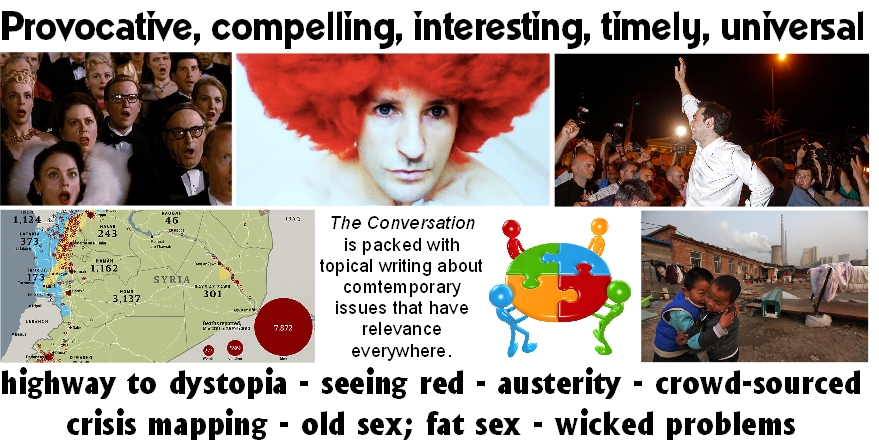
For some time now Columbia news, views & reviews has been incorporating articles from The Conversation, an Australian Website here. We believe that the articles published there are relevant, universal, timely, well-researched and well-documented. In the global world, all issues affect everyone. Academic writing and compelling graphics address a wide spectrum of issues that impact Australians … and everyone across the world … in many senses
According to The Conversation‘s home page, “(It) is an independent source of information, analysis and commentary from the university and research sector — written by acknowledged experts and delivered directly to the public. Our team of professional editors work with more than 2,800 academic authors to make this wealth of knowledge and expertise accessible to all. We aim to be a site you can trust. All published work will carry attribution of the authors’ expertise and, where appropriate, will disclose any potential conflicts of interest, and sources of funding. Where errors or misrepresentations occur, we will correct these promptly.”
A recent issue of The Conversation contains so many of these “provocative, compelling, relevant” writings that we just have to invite Columbia news, views & reviews readers to browse a few of them.
Highway to dystopia: “In that world of peripheral vision, essential for business, social and political leaders, it is surprising that the World Economic Forum’s report, Global Risks 2012 has not received greater publicity or provoked greater public interest. It is a measured examination of 50 major risks, clustered in economic, environmental, geopolitical, social and technological risk categories, facing the world in the next 10 years. [NOTE: Click here for Wikipedia’s narrative about dystopia.]
Crowd-sourced crisis mapping: “Web 2.0 tools and mobile technologies have lowered the barriers not just for people to access the internet but to create and share content. Through open-source, collaborative programs such as wikis, the creation and distribution of information has effectively been crowdsourced.”
Wicked problems: “Obesity. Climate change. Brain drain. Tax havens. War in Afghanistan. All have been described as “wicked problems.”
Old sex; fat sex: “Fat people having sex, ugly people having sex, old people having sex. All too readily our culture cringes, shudders, if not gags at the thought. After all, if film and television have taught us anything, only young and beautiful people have sex. In good lighting, on clean sheets, and always to satisfying ends.”
What red does to your head. “Colour is an extraordinary motivator. We sensibly caution against waving a red rag to a bull to avoid provocation – worthy but curious advice, since bulls cannot distinguish red from other colours. We use red roses to signify romantic intention, yellow roses to affirm friendships and white lilies to share grief. While the role of these colours for humans may be culturally acquired, the reaction to colour among animals is largely ‘hardwired’.”
Austerity abroad. “What does all this mean for Europe and for us? For Europe, last week most share markets are down by about 5%, and the euro itself dropped to a three-month low. The markets are spooked that this may be the beginning of the end for the euro. Paradoxically, however, these changes may represent the euro’s only hope of long-term survival.”
 Columbia news, views & reviews