“One carrier, AT&T, had more fatalities on its jobs than its three closest competitors combined … “
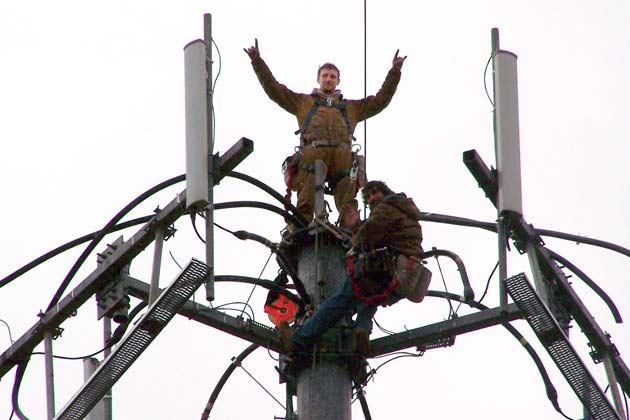
Tower climber Jay Guilford poses atop a cell tower. He was one of 11 climbers to die while working on AT&T jobs during a wave of cell service expansion from 2006 to 2008. Photo courtesy of Bridget Pierce.
This story was co-published with PBS Frontline, which will air a film version today. Check local listings.
“In the spring of 2008, AT&T was racing to roll out a new cell phone network to deliver music, video and online games at faster speeds.
“The network, known as 3G, was crucial to the company’s fortunes. AT&T’s cell service had been criticized by customers for its propensity to drop calls, a problem compounded when the company became the sole carrier for the iPhone.
“Jay Guilford was a tiny but vital cog in the carrier’s plans.
“On a clear evening in May, Guilford was dangling, 150 feet in the air, from a cell tower in southwest Indiana. He had been sent aloft to take pictures of AT&T antennas soon to be replaced by 3G equipment.
“Work complete, Guilford sped his descent by rappelling on a rope. Safety standards required him to step down the metal pole, peg by peg, using a special line that would catch automatically if he fell. But tower climbing is a field in which such rules are routinely ignored.
“‘Bouncy, bouncy,’ Guilford, 25, called jovially to men on the ground.
“Then, in an instant, the hook attaching the rope to the tower – broken and missing its safety latch – came loose. Guilford plummeted to the gravel below, landing feet first. The impact shattered his legs and burst his aorta. He bled to death in minutes.
“Cell phones are our era’s ubiquitous technology device. There are more active cell phones in the U.S. than people.
“An investigation by ProPublica and PBS “Frontline” shows that the convenience of mobile phones has come at a hefty price: Between 2003 and 2011, 50 climbers died working on cell sites, more than half of the nearly 100 who were killed on communications towers.
“Yet cell phone carriers’ connection to tower climbing deaths has remained invisible. They outsource this dangerous work to subcontractors, a practice increasingly common in risky businesses from coal mining to trucking to nuclear waste removal. If you look up the major cell carriers in the Occupational Safety and Health Administration’s database of workplace accident investigations, you will not find a single tower climber fatality listed.
“Guilford didn’t work for AT&T – he worked for a subcontracting outfit affiliated with a bigger subcontractor hired by a construction management firm working for AT&T.
“For each tower-related fatality since 2003, ProPublica and PBS “Frontline” traced the contracting chain from bottom to top, reviewing thousands of pages of government records and interviewing climbers, industry executives and labor experts.
“We found that in accident after accident, deadly missteps often resulted because climbers were shoddily equipped or received little training before being sent up hundreds of feet. To satisfy demands from carriers or large contractors, tower hands sometimes worked overnight or in dangerous conditions.
“One carrier, AT&T, had more fatalities on its jobs than its three closest competitors combined, our reporting revealed. Fifteen climbers died on jobs for AT&T since 2003. Over the same period, five climbers died on T-Mobile jobs, two died on Verizon jobs and one died on a job for Sprint.” Click here to continue reading this article at ProPublica.
“Built for a simpler era, OSHA struggles when tower climbers die” – ProPublica and PBS Frontline
 Columbia news, views & reviews