§ 43.7-701. Powers and Duties of the Mayor.
The Mayor shall have and exercise the following powers and duties:
1. The Mayor shall be the President of Council beginning with the effective date of this Charter, and thereafter.
2. The Mayor shall be the ceremonial head of the Borough Government and the official representative of the Borough and its people. The Mayor may designate any other elected or appointed official of the Borough to act in his stead.
3. The Mayor shall not have the right to vote upon any matter before the Council provided, however, if in the event any vote of Council results in a tie, the Mayor may cast a vote in order to resolve such tie or abstain from voting thereon. In all cases, however, the Mayor shall approve or veto any Ordinance of Council as set forth in § 43.6-607 of this Charter.
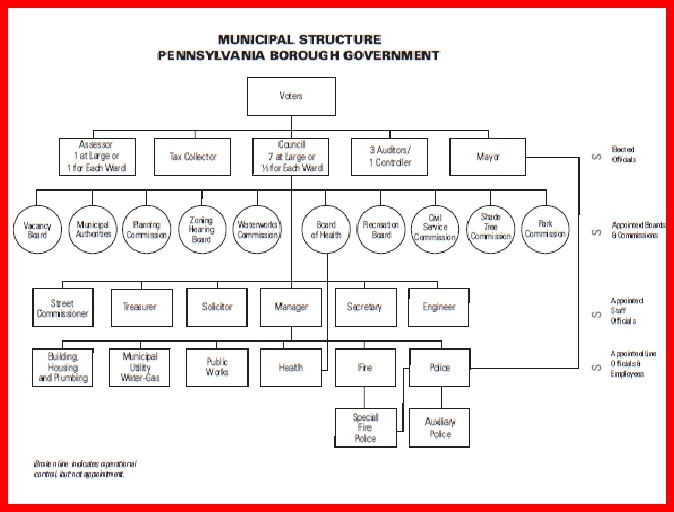
4. The Mayor shall have the duty to preserve order in the Borough and to be responsible for enforcement of all laws, ordinances and regulations of the Borough and for the direction and supervision of the Police Department. He shall appoint the Chief of Police with the approval of Council, and the Chief of Police shall be directly responsible to the Mayor.
5. Any emergency powers that Council may establish by ordinance to suppress mobs, riots and tumultuous assemblies, or to take over control in the case of emergency resulting from any natural or other disaster, shall devolve upon the mayor, unless Council, at the time of a specific emergency or disaster, shall determine that such emergency powers shall be exercised otherwise, for the duration of such emergency or disaster.
Source The provisions of this § 43.7-704 amended May 19, 1981, effective May 19, 1981; amended November 7, 1989, effective January 1, 1990. Immediately preceding text appears at serial pages (107067) to (107068).
Authority Over Borough Police: Mayor vs. Council
Note: Mayors of boroughs that have their own police force retain limited power over controlling the manner in which police discharge their duties. Because such control is often ill-defined and because of the professional nature and greater specialization associated with law enforcement, the mayor is now more often better suited to act as an intermediary between council and the department.
Also, in municipalities, including boroughs, where there is a regional police force or where there is contracting for police services, the mayor may be divested of any power he may have had over a borough force.

