(SOURCE: The Conversation)
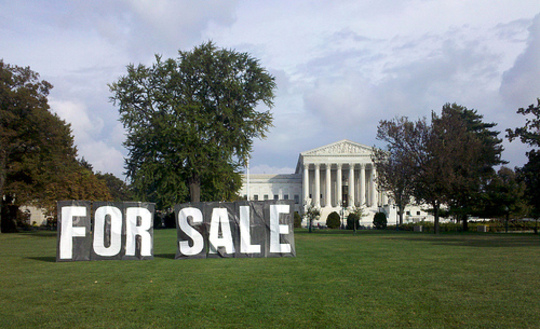 In the US, corporate personhood has enabled corporations to exercise undue influence on the electoral process. takomabibelot
A Supreme Court ruling in 2010, designed to clarify the parameters of free speech, has created a monster. Citizens United v. Federal Election Commission made much of corporate rights. It paid significantly less attention to corporate responsibilities. In enabling a literal reading of the First Amendment, the Supreme Court voided precedent and has allowed corporate entities to circumvent already flimsy campaign finance restrictions. In doing so, it has reduced transparency and accountability.
Concern over the capacity of corporate power to influence electoral outcomes has long exercised Congress. Legislative restrictions date back to 1907. Each reform, culminating in the McCain-Feingold Act, limit the amount any one individual or corporation can contribute in a given electoral cycle. The system is augmented by the provision of capped federal financing. Already weakened by the decision by Barack Obama to withdraw from federal financing in 2008 because of his campaign’s spectacular grassroots funding success, the system was completely destroyed by the Supreme Court’s decision.
In Citizens United, the Supreme Court held that so-called independent Super political action committees (Super PACs) can raise unlimited funds from corporate interests or trade unions as long as there is no formal link to political campaigns.
The decision has transformed the electoral landscape. As The Economist noted on February 25 this year, Super PACs linked to each of the remaining Republican contenders for the forthcoming presidential election raised more than the campaigns themselves. By no means is this a phenomena linked to the Republican Party; President Obama’s campaign is equally indebted to the structure.
The Supreme Court had intended to protect free speech. The majority opinion was set out by Justice Kennedy. “If the First Amendment has any force, it prohibits Congress from fining or jailing citizens or associations of citizens for simply engaging in political speech,” he argued. “Political speech is indispensable to decision-making in a democracy and this is not less true because the speech comes from a corporation rather than an individual.”
Far from strengthening free speech, the decision in Citizens United has contributed to its erosion. To make matters worse, the consequences were foreshadowed in the dissenting opinion.
“Unregulated corporate electioneering can drown out the voices of real people. It can decrease listener’s exposure to relevant viewpoints. It can generate cynicism and disenchantment. It can chill out the speech of those who hold office and it decrease the willingness and capacity of citizens to participate in self-government,” argued Justice Stevens.
Nowhere is that cynicism more justified than in the battles over the implementation of the Dodd-Frank Act, the legislation introduced in the aftermath of the sub-prime crisis.
As I noted on these pages last month, the financial services industry has used the Super PAC as an opportunity to advance its agenda -surreptitiously.
Restore our Future, the Super PAC most associated with Mitt Romney, is dominated by the financial services industry. You would not know this from its website. No information is provided on financing or purpose, thus transacting around disclosure obligations.
Click here to continue reading this article at The Conversation.
 Columbia news, views & reviews